HOW TO DESTROY THE EARTH
Man, I love days like this. Not only did I stumble across a link with the above title, but the web page actually delivers. I'm probably the last person to see it, but that's fine.
The talented creator of the page has a FAQ -- why would someone want to destroy the Earth, anyway, right? I mean, I understand, but that's me. It was nice to read all the reasons so clearly laid out -- it was like someone understood me, finally. My favorite reasons are below. They're my favorite because they're funny, not necessarily because the reasons are my own. Reason #7 might be mine, but I can't confirm that due to a complicated legal rationale.
1. Because it is there -- A response first given by - correct me if I'm wrong - Edmund Hillary after being relentlessly questioned as to why he desired to become the first man to climb to the highest point on Earth, the peak of Mount Everest. It did for him and it can do for you. Who needs a reason? The doing of the thing is its own reward.
2. To further science -- You'll be employing the scientific principles of [whatever method you use] on a greater scale than ever before. You'll have recording devices observing the event from all angles and on all wavelengths. The telemetry taken from the destruction of the Earth will reveal more about the universe, and science, and the Earth itself than anybody can possibly imagine! Isn't that worth it?
3. Special effects no longer satisfy me -- One can't argue with the fact that the total annihilation of an object of the Earth's size is going to be pretty spectacular however it happens. If you are the kind of person who likes explosions and implosions and other destructive events, then this is going to be the biggest you're likely to experience in a lifetime.
7. To make a point -- Anything along the lines of "They laughed at me at the Academy, I'll show them, I'll show them all!!" would fall under this category, though it could also be pegged as a psychological reason, below.
Regretably, the author would prefer if people like me who were inclined to copy his page and past it onto their own would not do so, and I will respect his wishes. Read the preamble below, and then click to learn how to do some Earth-destroyin' of your own.
Preamble
Destroying the Earth is harder than you may have been led to believe.
You've seen the action movies where the bad guy threatens to destroy the Earth. You've heard people on the news claiming that the next nuclear war or cutting down rainforests or persisting in releasing hideous quantities of pollution into the atmosphere threatens to end the world.
Fools.
The Earth was built to last. It is a 4,550,000,000-year-old, 5,973,600,000,000,000,000,000-tonne ball of iron. It has taken more devastating asteroid hits in its lifetime than you've had hot dinners, and lo, it still orbits merrily. So my first piece of advice to you, dear would-be Earth-destroyer, is: do NOT think this will be easy.
This is not a guide for wusses whose aim is merely to wipe out humanity. I (Sam Hughes) can in no way guarantee the complete extinction of the human race via any of these methods, real or imaginary. Humanity is wily and resourceful, and many of the methods outlined below will take many years to even become available, let alone implement, by which time mankind may well have spread to other planets; indeed, other star systems. If total human genocide is your ultimate goal, you are reading the wrong document. There are far more efficient ways of doing this, many which are available and feasible RIGHT NOW. Nor is this a guide for those wanting to annihilate everything from single-celled life upwards, render Earth uninhabitable or simply conquer it. These are trivial goals in comparison.
This is a guide for those who do not want the Earth to be there anymore.
Tuesday, August 09, 2005

I've had days like this.
BANK SORRY OVER BLUNDER
A bank has apologised to a customer after sending him a debit card bearing the name "Dick Head".
NatWest said it had launched an inquiry after Chris Lancaster, 18, of Tiptree, Essex, received a cash card with the wording: "Mr C Lancaster Dick Head".
Mr Lancaster said he did not spot the insult until he was handing over the card in a supermarket to pay for something a few days after it arrived in the post.
"I couldn't believe it," he said.
"When I got the card out I saw the name embossed on it. I was so embarrassed I put it back in my wallet.
"I know I've been overdrawn a few times but I've done nothing to deserve this.
"The bank said it must have been a worker with a grudge."
A NatWest spokesman said: "We have apologised unreservedly to Mr Lancaster.
"This is completely unacceptable and we have launched an investigation."
BANK SORRY OVER BLUNDER
A bank has apologised to a customer after sending him a debit card bearing the name "Dick Head".
NatWest said it had launched an inquiry after Chris Lancaster, 18, of Tiptree, Essex, received a cash card with the wording: "Mr C Lancaster Dick Head".
Mr Lancaster said he did not spot the insult until he was handing over the card in a supermarket to pay for something a few days after it arrived in the post.
"I couldn't believe it," he said.
"When I got the card out I saw the name embossed on it. I was so embarrassed I put it back in my wallet.
"I know I've been overdrawn a few times but I've done nothing to deserve this.
"The bank said it must have been a worker with a grudge."
A NatWest spokesman said: "We have apologised unreservedly to Mr Lancaster.
"This is completely unacceptable and we have launched an investigation."
Lawsuit claims Chevron paid for deadly raids on 2 Nigerian villages
By Elise Ackerman, Knight Ridder NewspapersTue Aug 2, 3:42 PM ET
SAN FRANCISCO - The bodies of the dead Nigerian villagers hadn't yet grown cold when a navy captain presented Chevron with a bill: 15,000 naira, or $165, for responding to "attacks from Opia village against security agents."
Within 24 hours Chevron paid up, but it would be years before the California-based company would acknowledge the role it played in the destruction of Opia and another small village called Ikenyan in Nigeria's oil-rich Niger River Delta.
The receipt for the Jan. 4, 1999, military raid, which left four villagers dead and nearly 70 missing and presumed dead, came to light this summer as part of a federal lawsuit filed on behalf of the victims in U.S. District Court in San Francisco.
Chevron has denied any responsibility for the deaths or injuries that occurred that day. Charles Stewart, a Chevron spokesman, said its payment to the captain reflected "a longstanding industry practice of paying a small amount for each day" to military personnel who protected "the people and the property of the oil companies located in the Niger Delta."
The appearance of the receipt came at a ticklish moment for Chevron, the second-largest U.S. oil company, based in San Ramon, Calif. Chevron has offered $17 billion to buy Unocal, an oil-and-gas exploration company, and had used China's human rights record as one of its arguments against a competing bid by CNOOC, China's third-largest oil producer.
CNOOC withdrew its bid for Unocal Tuesday, citing political opposition in the United States. "This political environment has made it very difficult for us to accurately assess our chance of success, creating a level of uncertainty that presents an unacceptable risk to our ability to secure this transaction," CNOOC said in a statement. Unocal shareholders are scheduled to vote on Chevron's bid on Aug. 10.
Cindy Cohn, legal director for the Electronic Frontier Foundation, one of several law firms representing the plaintiffs in the San Francisco case, said Chevron's own human rights record is worthy of examination, in light of complaints about China's record.
"If that's their argument, it's important to look at Chevron's own record in that regard," she said.
Chevron argues that the violence at Opia and Ikenyan was due to tribal rivalries. "It's important to look at the allegations of this lawsuit against the backdrop of violence and communal unrest in Nigeria," Stewart said.
But company documents that have surfaced in the litigation describe how the attacks took place a day after Opia youths had visited a nearby Chevron drilling rig and demanded compensation.
Such demands have been common since the mid-1990s, as tribal communities around the delta have sought a greater share of oil wealth and compensation for spoiled fishing areas and blighted farm land.
When oil exploration began in the 1950s, residents hoped for an economic bonanza. But the anticipated boom never materialized. Half a century later, the 20 million residents who live in the Niger River Delta continue to eke out a bleak existence while the oil fields surrounding their communities rank among the top producers of high-grade petroleum in the world.
By the late 1990s, local demands were being met with violence. In 1995 the military government executed Ken Saro-Wiwa, a prominent playwright and activist with the Ogoni tribe, along with eight sympathizers, and in May 1998, Nigerian forces attacked about 100 members of the Ilaje tribe who were occupying an offshore oil platform belonging to Chevron's Nigerian subsidiary, killing two protesters.
Later that year, Ijaw youth began holding oil company employees hostage.
In December, Ijaw activists issued "The Kaiama Declaration," which called on all oil companies to stop "exploration and exploitation" activities in Ijaw areas by Dec. 30.
"We are tired of gas flaring; oil spillages, blowouts and being labeled saboteurs and terrorists," the declaration stated. "It is a case of preparing the noose for our own hanging."
Chevron began evacuating staff from Ijaw areas and preparing for mayhem.
In late 1998, activists from Opia, a community of thatched huts along Robin Creek, decided to press their grievances with a local Chevron representative.
Months earlier, they had submitted a list of items, including fishing nets, traps, hooks and other materials, that had been destroyed by Chevron's tug boats and floating barges.
Attorneys representing surviving villagers say their clients, who live without running water, electricity and newspapers, set out to seize a drilling rig Jan. 3.
They found the rig deserted, except for guards who told them to leave. "They rushed at them and they started beating them, you know, and they fell into the river," Anthony Lawuru, the chairman of the community, testified during a deposition in April 2005.
Back at the village, there was an urgent meeting.
"We'd been having a cordial relationship, even with the security men," Lawuru said. A delegation that included women and elders decided to return with the youths to the rig the next day in order to demonstrate that the youths had community support.
The next day, the guards greeted the delegation with gunfire.
Shaken, the villagers returned to Opia. Not more than 15 minutes had passed before a blue-and-white helicopter dropped out of the sky. As it hovered above the center of the village, just below the level of the coconut trees, the helicopter door opened and gunfire sprayed out, according to Lawuru's deposition.
"We were running into the bush; we heard the gun as it was going round," Lawuru said.
He estimated the fusillade continued 15 to 20 minutes. When villagers emerged from the bush nearly all the houses in the village were burning. Canoes, fishing materials, boats had been shot up and burned. Lawuru's brother lay dead.
There was panic as villagers rushed to pack their canoes and flee. In the confusion, Lawuru recalled, four boats known as "sea trucks" arrived, full of men in army uniforms. "They did not land before they started shooting," Lawuru said. "Then we started running again. Another round of running."
The soldiers then moved downstream to Ikenyan. There, the scene was replayed.
In a declaration submitted in federal court in San Francisco, John Ikenyan, the son of the village chief, said a helicopter first appeared over the houses. "I thought maybe that Chevron was coming to see my father again as they had before," Ikenyan said. Women and children waved.
A shot was fired from the helicopter and then another. Villagers fled to the bush.
When the villagers returned, they found their homes on fire. With no fire engine, no hoses and no pumps, they were unable to squelch the flames.
The sea trucks arrived. Once again, the villagers ran for the bush. Ikenyan said his father, the chief, stayed behind and was shot by the riverside.
"I later learned that many people had been killed or disappeared or were wounded at both Opia and Ikenyan on January 4," Ikenyan said.
According to Human Rights Watch, a total of four bodies were recovered from the two villages. Sixty-eight people were missing and believed dead.
Barbara Enloe Hadsell, an attorney for the villagers, said that in addition to paying the security forces, Chevron loaned them the helicopter that was used in the attack.
She said Chevron personnel not only accompanied the soldiers as they flew to Robin Creek but also directed the pilot to "deviate from his course" to pursue villagers who were "getting away."
Stewart, the Chevron spokesman, said Chevron's Nigerian subsidiary helped transport the military reinforcements to the rig after gunfire was heard on the radio. He also acknowledged that a Nigerian military officer aboard one of the helicopters "discharged a gun during flight."
But Stewart said Chevron hadn't authorized the weapons to be fired and said the shooting occurred when no village was in sight.
"We are confident as the case progresses, Chevron will be vindicated," he said.
A jury trial on the villagers' claim is currently scheduled for the fall of 2006 in federal court in San Francisco.
By Elise Ackerman, Knight Ridder NewspapersTue Aug 2, 3:42 PM ET
SAN FRANCISCO - The bodies of the dead Nigerian villagers hadn't yet grown cold when a navy captain presented Chevron with a bill: 15,000 naira, or $165, for responding to "attacks from Opia village against security agents."
Within 24 hours Chevron paid up, but it would be years before the California-based company would acknowledge the role it played in the destruction of Opia and another small village called Ikenyan in Nigeria's oil-rich Niger River Delta.
The receipt for the Jan. 4, 1999, military raid, which left four villagers dead and nearly 70 missing and presumed dead, came to light this summer as part of a federal lawsuit filed on behalf of the victims in U.S. District Court in San Francisco.
Chevron has denied any responsibility for the deaths or injuries that occurred that day. Charles Stewart, a Chevron spokesman, said its payment to the captain reflected "a longstanding industry practice of paying a small amount for each day" to military personnel who protected "the people and the property of the oil companies located in the Niger Delta."
The appearance of the receipt came at a ticklish moment for Chevron, the second-largest U.S. oil company, based in San Ramon, Calif. Chevron has offered $17 billion to buy Unocal, an oil-and-gas exploration company, and had used China's human rights record as one of its arguments against a competing bid by CNOOC, China's third-largest oil producer.
CNOOC withdrew its bid for Unocal Tuesday, citing political opposition in the United States. "This political environment has made it very difficult for us to accurately assess our chance of success, creating a level of uncertainty that presents an unacceptable risk to our ability to secure this transaction," CNOOC said in a statement. Unocal shareholders are scheduled to vote on Chevron's bid on Aug. 10.
Cindy Cohn, legal director for the Electronic Frontier Foundation, one of several law firms representing the plaintiffs in the San Francisco case, said Chevron's own human rights record is worthy of examination, in light of complaints about China's record.
"If that's their argument, it's important to look at Chevron's own record in that regard," she said.
Chevron argues that the violence at Opia and Ikenyan was due to tribal rivalries. "It's important to look at the allegations of this lawsuit against the backdrop of violence and communal unrest in Nigeria," Stewart said.
But company documents that have surfaced in the litigation describe how the attacks took place a day after Opia youths had visited a nearby Chevron drilling rig and demanded compensation.
Such demands have been common since the mid-1990s, as tribal communities around the delta have sought a greater share of oil wealth and compensation for spoiled fishing areas and blighted farm land.
When oil exploration began in the 1950s, residents hoped for an economic bonanza. But the anticipated boom never materialized. Half a century later, the 20 million residents who live in the Niger River Delta continue to eke out a bleak existence while the oil fields surrounding their communities rank among the top producers of high-grade petroleum in the world.
By the late 1990s, local demands were being met with violence. In 1995 the military government executed Ken Saro-Wiwa, a prominent playwright and activist with the Ogoni tribe, along with eight sympathizers, and in May 1998, Nigerian forces attacked about 100 members of the Ilaje tribe who were occupying an offshore oil platform belonging to Chevron's Nigerian subsidiary, killing two protesters.
Later that year, Ijaw youth began holding oil company employees hostage.
In December, Ijaw activists issued "The Kaiama Declaration," which called on all oil companies to stop "exploration and exploitation" activities in Ijaw areas by Dec. 30.
"We are tired of gas flaring; oil spillages, blowouts and being labeled saboteurs and terrorists," the declaration stated. "It is a case of preparing the noose for our own hanging."
Chevron began evacuating staff from Ijaw areas and preparing for mayhem.
In late 1998, activists from Opia, a community of thatched huts along Robin Creek, decided to press their grievances with a local Chevron representative.
Months earlier, they had submitted a list of items, including fishing nets, traps, hooks and other materials, that had been destroyed by Chevron's tug boats and floating barges.
Attorneys representing surviving villagers say their clients, who live without running water, electricity and newspapers, set out to seize a drilling rig Jan. 3.
They found the rig deserted, except for guards who told them to leave. "They rushed at them and they started beating them, you know, and they fell into the river," Anthony Lawuru, the chairman of the community, testified during a deposition in April 2005.
Back at the village, there was an urgent meeting.
"We'd been having a cordial relationship, even with the security men," Lawuru said. A delegation that included women and elders decided to return with the youths to the rig the next day in order to demonstrate that the youths had community support.
The next day, the guards greeted the delegation with gunfire.
Shaken, the villagers returned to Opia. Not more than 15 minutes had passed before a blue-and-white helicopter dropped out of the sky. As it hovered above the center of the village, just below the level of the coconut trees, the helicopter door opened and gunfire sprayed out, according to Lawuru's deposition.
"We were running into the bush; we heard the gun as it was going round," Lawuru said.
He estimated the fusillade continued 15 to 20 minutes. When villagers emerged from the bush nearly all the houses in the village were burning. Canoes, fishing materials, boats had been shot up and burned. Lawuru's brother lay dead.
There was panic as villagers rushed to pack their canoes and flee. In the confusion, Lawuru recalled, four boats known as "sea trucks" arrived, full of men in army uniforms. "They did not land before they started shooting," Lawuru said. "Then we started running again. Another round of running."
The soldiers then moved downstream to Ikenyan. There, the scene was replayed.
In a declaration submitted in federal court in San Francisco, John Ikenyan, the son of the village chief, said a helicopter first appeared over the houses. "I thought maybe that Chevron was coming to see my father again as they had before," Ikenyan said. Women and children waved.
A shot was fired from the helicopter and then another. Villagers fled to the bush.
When the villagers returned, they found their homes on fire. With no fire engine, no hoses and no pumps, they were unable to squelch the flames.
The sea trucks arrived. Once again, the villagers ran for the bush. Ikenyan said his father, the chief, stayed behind and was shot by the riverside.
"I later learned that many people had been killed or disappeared or were wounded at both Opia and Ikenyan on January 4," Ikenyan said.
According to Human Rights Watch, a total of four bodies were recovered from the two villages. Sixty-eight people were missing and believed dead.
Barbara Enloe Hadsell, an attorney for the villagers, said that in addition to paying the security forces, Chevron loaned them the helicopter that was used in the attack.
She said Chevron personnel not only accompanied the soldiers as they flew to Robin Creek but also directed the pilot to "deviate from his course" to pursue villagers who were "getting away."
Stewart, the Chevron spokesman, said Chevron's Nigerian subsidiary helped transport the military reinforcements to the rig after gunfire was heard on the radio. He also acknowledged that a Nigerian military officer aboard one of the helicopters "discharged a gun during flight."
But Stewart said Chevron hadn't authorized the weapons to be fired and said the shooting occurred when no village was in sight.
"We are confident as the case progresses, Chevron will be vindicated," he said.
A jury trial on the villagers' claim is currently scheduled for the fall of 2006 in federal court in San Francisco.
Monday, August 08, 2005
My dream has always been to direct a music video in the classic style of the form's early days, with a speedboat or a man in white singing on a beach. Now I knowm that when the times comes for me to live my dream, I will make a cover version of this.
I THOUGHT GETTING TATTOOS WAS AGAINST JEWISH BELIEFS
Former SPICE GIRL VICTORIA BECKHAM and her husband DAVID have celebrated their sixth wedding anniversary by getting matching Hebrew tattoos. The golden couple honoured David's family's Jewish beliefs, by getting the phrase "I am my beloved, my beloved is mine" from the Hebrew bible's Song of Songs inked on their skin, reports British newspaper The Sun.
Former SPICE GIRL VICTORIA BECKHAM and her husband DAVID have celebrated their sixth wedding anniversary by getting matching Hebrew tattoos. The golden couple honoured David's family's Jewish beliefs, by getting the phrase "I am my beloved, my beloved is mine" from the Hebrew bible's Song of Songs inked on their skin, reports British newspaper The Sun.
Sunday, August 07, 2005


Saturday, August 06, 2005
I wanted to make some rice today in my steamer. The last time I made rice was a couple weeks ago, when I made some vinegarized rice and promptly forgot about it in the fridge. The rice had actually eaten through the bottom of the pot. I was bummed at the ruin of my rice steamer, but still, I'm pleased by the science lesson I received.
Thursday, August 04, 2005
THE BOWELS OF POWER
After watching Bob Novak throw a tantrum on CNN, I stuck around for some inane banter as two cut-outs ignored the pink elephant that just stormed off the set. My time was not wasted, as one of them named my next book. He referred to "The Bowels of Power." Referring to Florida, to Kathleen Harris running for office in Florida. The Bowels of Power. I like it.
After watching Bob Novak throw a tantrum on CNN, I stuck around for some inane banter as two cut-outs ignored the pink elephant that just stormed off the set. My time was not wasted, as one of them named my next book. He referred to "The Bowels of Power." Referring to Florida, to Kathleen Harris running for office in Florida. The Bowels of Power. I like it.
THREE AMAZING NEWS STORIES
Virginia Millionaire Buys Himself a Ghost Town
By Doug Struck, Washington Post Foreign Service Sat Jul 30, 1:00 AM ET
KITSAULT, B.C. -- The Millionaire Who Bought a Town likes to save a buck. He breakfasts at McDonald's, flies economy class and asks for a doggie bag when he doesn't finish his meal at cheap motel restaurants.
ADVERTISEMENT
But when, several months ago, the Virginia-based businessman saw a news story about a whole town being for sale in remote western Canada, he called the same day to offer a check for $5.7 million -- sight unseen.
Today, Krishnan Suthanthiran owns Kitsault, a ghost town abandoned by miners' families more than 22 years ago and preserved like a museum display of suburbia -- though one through which bears occasionally wander.
Suthanthiran, who was born in India and made his fortune selling medical devices and real estate in the Washington area, said he jumped at the chance to buy Kitsault because, "one, it is beautiful up there, and two, I couldn't believe it wasn't being used. I said if nobody else could figure out what to do with a town, I can."
His ideas for transforming the empty community, located in a majestic natural setting, tumble forth:
Kitsault will become an eco-tourist destination or an artist's colony. He will hold conferences, gathering scientists for forums and evening salmon-roasts on the beach. Wedding receptions. A corporate retreat. A movie set. Skiing, hiking, a spa, bans on smoking and cars, maybe a high-speed hydrofoil to bring tourists 85 miles from Prince Rupert.
"I feel like a kid in a candy shop," he said.
Suthanthiran has avoided publicity in the past, content with his work and a growing list of philanthropy projects in India, Canada and the United States. Many involve small scholarships, the kind of boost that enabled him to leave home for college at 15 with only a collection of donations from neighbors in his pocket.
"I do believe in education," he said. "If you're going to eliminate poverty, you need to eliminate ignorance."
At 56, after quietly building his businesses for 28 years, Suthanthiran has plunged into a flurry of financial acquisitions. In the last year, he has moved to buy half a dozen companies. Most are medical concerns that complement his own, Best Medical International. But the purchases also include a Vancouver video production company and now -- the splashiest buy -- a ghost town.
"I guess Kitsault will bring me more into the open," Suthanthiran said with little enthusiasm during an interview on the long, bumpy gravel road stretching 140 miles from Terrace, a town in western British Columbia, to the old mining community.
Kitsault, 500 miles northwest of Vancouver, was to be a model mining town. Instead, it became a monument to corporate misjudgment. In the late 1970s, Amax of Canada Limited chose to reopen a local mine, dormant since 1972, that produced molybdenum, a metal used to harden steel.
The setting is stunning: Green-cloaked mountains crested with streaks of snow plunge toward lakes and river gorges. A tidal estuary by the town teems with shrimp and salmon. Curious harbor seals poke up their heads from the water beneath the swiftly moving shadows of bald eagles.
Amax created a modern, planned community to house 1,200 miners and their families. The company built seven apartment buildings and 92 suburban homes with aluminum siding and green lawns. The town boasted a recreation center with a gleaming hardwood-floor gym and a swimming pool, health clinic, community center, library and day-care facility.
"It was an ideal place for a family," said Larry Payjack, who opened a sporting goods store in the town's small mall. There was no crime; residents formed a bear watch to collect the kids when a bear wandered through.
But just as the families were getting settled, the price of molybdenum plunged, from a $15-a-ton high to $3. An oversupply of the ore from competing mines and the recession of the 1980s killed off the "moly" market.
The company stockpiled the ore in one-ton bags on the beach for a while, recalled Art Hill, an electrician. Then, in November 1982, it ordered the operation closed, and within months, the town was abandoned. Most of the mining families, accustomed to a boom-and-bust lifestyle, moved to places where dreams still hid in seams of coal, asbestos or gold.
Kitsault was left empty and eerie. The glasses are still stacked for the next pint at the Maple Leaf Pub. The sign-in sheet at the day-care center shows a dwindling roster of 3-year-olds. Amber LaForge was the last to attend -- alone -- on June 27, 1983. The pool was left filled. Residents left the doors unlocked.
Amax and the successive owner, the giant mining company Phelps Dodge, kept a caretaker there who mowed the lawns and kept the heat on in the winter, keeping the town surprisingly intact.
"It's nice and peaceful here in the winter," said Jim Essay, 65, who lived with his wife, Maggie, as a Kitsault caretaker for the last two years. "Maggie did a lot of cross-stitching. We played cards a lot."
There were occasional attempts to sell the property, but no takers until the price dropped and Suthanthiran noticed the ghost town for sale.
He had a history with Canada. He had come to Carleton University in Ottawa in 1969 at age 20 on a postgraduate scholarship after leaving India, where a friend's father had taken up a collection to rescue the smart young man from his family grocery store and send him to college.
Suthanthiran got a master's degree in engineering and then went to Washington to make medical devices with an oncologist. He started his own company in 1977, specializing in sophisticated radiation treatment catheters used to fight cancer, the disease that had claimed his father in India. The company now employs a staff of 130 in Virginia and 100 in Europe.
Its owner is not a flashy millionaire. No gold Rolex -- he wears a plastic sports watch and white socks. He says he hasn't been shopping in three years. He does not own a car. He spends more than half his time on the road, so when he flies back to Virginia, he rents a car to drive to the house he bought 22 years ago in quiet Mason Neck.
The only extravagance he admits to is a two-bedroom apartment in Las Vegas. He doesn't gamble, he says, but likes the shows and marvels at the operation of the giant hotels.
Suthanthiran has neither a wife nor children; the closest he came, he said, was when he was 28 and received a surprise call from a family who said they had arranged with his mother in India for him to marry their daughter. He balked, and since then, he said, "I've been busy." He works seven days a week, his ear joined to a telephone. He hasn't borrowed money in 20 years, he said.
But something about Kitsault has brought out the dreamer in him.
"Just look at this place," Suthanthiran gushed as he wandered around the empty buildings of his town. "Look at these paved roads. Look at the gym -- how many schools would love to have a gym like this? Look at this scenery. I've got a mailing list of thousands of doctors who would love to come up here to get away for a week."
The frozen-in-time look of the town is deceptive, though. Ants are chewing away at the wood foundations; mold has crept into the eaves. The electrical wiring is brittle, and the sewage system, which runs straight into the estuary, probably will not pass today's standards.
"I don't think he really knows what he's gotten into," mused Edmond Wright, secretary-treasurer of the Nisga'a Lisims native government, which represents the aboriginal villages that are Kitsault's closest neighbors. "We're really out in the boondocks here."
Besides, native officials told Suthanthiran at a recent meeting to discuss his plans, the 6,200 Nisga'a have treaty rights and a well-vetted development blueprint for the area. Over a hospitable lunch of wild salmon, the Nisga'a officials politely scolded Suthanthiran for rushing ahead without consulting them.
"You've got too much money," Wright chided him.
Suthanthiran is undeterred by skeptics.
"If I wasn't an optimist, I'd still be in my home town in India running a grocery, with 10 kids," he said. "Land development is not for the fainthearted."
His plans do not include capitalizing on Kitsault's ghost-town history, however.
"We're going to focus on the future," he said. "People are going to say, 'Wow.' And they will forget about the past. The ghosts will be exorcised."
THINK OF THE BARTENDER
I don't take any glee on the tragic circumstances of this poor woman's death. But the player I feel for the most is that bartender. Man, hearing murder confessions just shouldn't be part of anyone's job. It's one thing to put up with drunk strangers confessing inadviseable crushes, or drunken lectures about national politics. But for a guy to just let you know about the brutal homicide he just executed on his wife, it'd just be depressing.
Man Gets Death for Killing Wife After Sex
By Associated Press
August 4, 2005, 11:41 AM EDT
PANAMA CITY, Fla. -- A man who got angry with his wife because she wanted to cuddle after sex when what he really wanted to do was watch sports on television was sentenced to death for killing her with a claw hammer.
Christopher Offord, 30, was sentenced Wednesday by Circuit Judge Dedee Costello, who said the brutality of the crime outweighed any mental problems Offord may have had.
"The defendant struck his wife approximately 70 individual blows after spending a happy interlude with her," the judge said. "Her desire to cuddle after sex does not justify the extremely violent, brutal response of the defendant."
Offord pleaded guilty to first-degree murder in the 2004 slaying of Dana Noser, 40, at his apartment.
He confessed to a bartender at a sports bar before his arrest. He told investigators that his wife had been nagging him to come back to bed.
Offord did not speak in court but said in a jailhouse interview in June: "I figured I killed her so I deserve to die."
TONIGHT ON AN ALL NEW SIMPSONS
Seriously, I really think there was an episode where Homer did this. The guy is bald, just like Homer Simpson.
And what's up with a new story calling them "cops?" I suppose it's more colorful, but it seems like a proper term like "police" would be more appropriate for a mainstream news report.
Cops: Man Fabricated Hitchhiker's Death To Make Wife Leave
POSTED: 3:38 pm EDT August 2, 2005
UPDATED: 12:30 pm EDT August 3, 2005
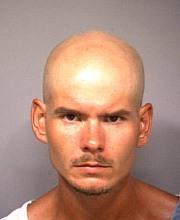
A 28-year-old man in Marion County, Fla., was arrested Tuesday for making up a story that he killed a hitchhiker and dumped his body in the forest in an effort to persuade his wife to leave him, according to police.
Teddy Akin was interviewed by police and admitted the report was false and that he found the wallet at a newspaper box at Nuby's Corner located near Highway 314. He told investigators that he was having problems with his wife and hoped that this story would make her leave him, the report said.
Investigators said Teddy Akin told his wife he killed a man and then dumped the body off east Highway 40.
Akin also told detectives at the Ocala police department that he left the body by the interstate and turned in a wallet belonging to Dennis Allen of Utah.
The Marion County Sheriff's Office began a land and air search of areas around Highway 40 but did not locate a body.
Akin was interviewed again by police and admitted the report was false and that he found the wallet at a newspaper box at Nuby's Corner located near Highway 314.
He told investigators that he was having problems with his wife and hoped that this story would make her leave him, the report said.
Detectives contacted Dennis Allen in Utah who confirmed that he had lost his wallet while visiting Ocala and that he did not know Akin or take a ride with him.
Akin was arrested for filing a false report and theft.
The sheriff's office also said they would probably bill Akin for the cost of their seven-hour search, Capt. Thomas Bibb said.
"This was something that cost us a lot of time and energy," Bibb said.
AND A SPECIAL THIRD-AND-A-HALF STORY
This linked from the story about the guy who made up the bullshit about being a serial killer. It's a little "Girls Gone Wild" for a news station to be sponsoring, right? I ahve to say, I found it all interesting, and so I've decided to compose what I'm too lazy to even bother to laughibly refer to as an investigative report.
Who is the hottest hottie in Central Fllorida?

Several local women are competing for the crown of "Hottest Hottie" and a trip to the MTV Music Awards with Club Paris owners Paris Hilton and Fred Khalilian.
Each Saturday during the broadcast of "Big Brother" on WKMG-TV, Local 6 will eliminate one woman who received the lowest number of votes from online voting and live voting at Club Paris.
The winner will be announced live on Sept. 3 from Club Paris.
Click on the Local 6 slideshow to meet the women and then, click here to vote for your favorite contestant. Voting will also be held a Club Paris on Thursday nights.
The winner will also receive a makeover, a shopping spree and will be named the Club Paris nationwide representative for one year.
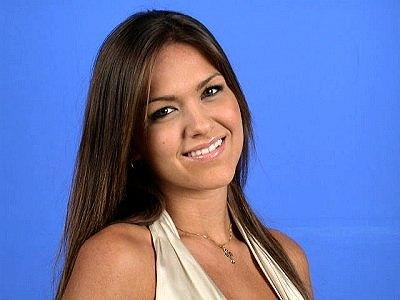 Name: Jessica Bain
Age: 18
Home: Lakeland
Measurements: 34-28-32
Favorite Food: Cheesecake
Favorite type of music: Country and Hip-Hop
Favorite movie: "Billy Madison"
Favorite saying: "If it’s meant to be, it’ll happen."
Career Goal: Real estate agent or Broadcaster.
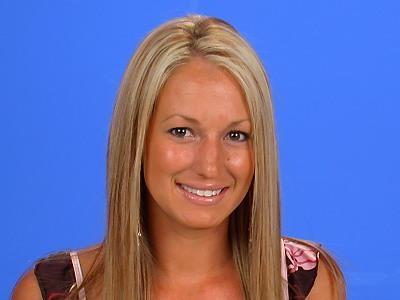 Name: Christina Harrison
Age: 21
Home: Melbourne
Measurements: 34-25-32
Favorite Food: Ice Cream
Favorite type of music: Pop & Techno
Favorite movie: Wedding Crashers
Favorite saying: "What doesn’t break you, only makes you stronger"
Career Goal: Spokesperson for a local company.
 Name: Jessyca Jones
Age: 18
Home: Orlando
Measurements: 36-28-32
Favorite Food: Ice Cream
Favorite type of music: Reggae
Favorite movie: "Billy Madison"
Favorite saying: "Life is short. Live it to the fullest."
Career Goal: Fashion Designer
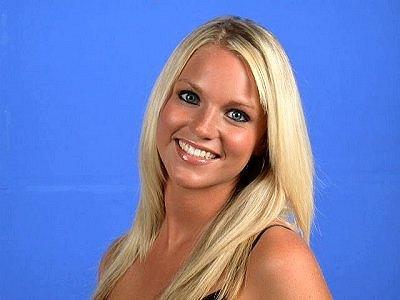 Name: Heather Peters
Age: 19
Home: Orlando
Measurements: 34-28-32
Favorite Food: Spaghetti
Favorite type of music: Rap, R& B, Country
Favorite movie: "Billy Madison"
Favorite saying: "Live the life you love, and love the life you live."
Career Goal: Plastic surgeon or Dermatologist
 Name: Amanda Zitzman
Age: 19
Home: Orlando
Measurements: 32-26-34
Favorite Food: Chicken Quesadilla from Taco Bell
Favorite type of music: Rap
Favorite movie: "Ace Ventura Pet Detective" – Jim Carrey is hilarious!
Favorite saying: "That’s hot!"
Career Goal: I'm a writer and fashion fanatic so I would love to own my own fashion magazine.
Surprisingly, it was not a hard choice. Jessica Bain was the first candidate, and I was immediately taken by her tomboyish attitude and smoker voice. I was intimidated and intrigued. She's really lucky she won me over with the video/,because her answers left me cold. Her best answer was that her favorite music is country and hip hop, which is pretty sad.
Her tape was really the only one I cared for, actually. I'm not just saying that to avoid posting links to the other five tapes. I had hoped to like Heather Peters, because of her desire to be a plastic surgeon or a dermatologist. Likewise, Amanda Zitman had a head start thanks to her literary aspiration, and a phot which suggested interesting, perhaps ethnic, facial characteristics. No luck, they were both doofs. I kind of see this as a low-level political race, in the same spirit as a college stdent government race, perhaps, but with more influence and charm. I was disapppointed there weren't better candidates. And to be really honest, I'm a little wigged out by how similar Christina Harrison and Jessyca James look.
I was going to go back and re-read some of their answers, and make some biting remarks on the state of celebrity culture, the over-commodification of self, and the weird, and probably unearned, sense of class contempt that I wonder if I'm feeling when I read stories about people like this. But it was too depressing to go back. Society's loss.
Currently, Jessica Bain is in fifth place, with 8 percent of the vote.
Virginia Millionaire Buys Himself a Ghost Town
By Doug Struck, Washington Post Foreign Service Sat Jul 30, 1:00 AM ET
KITSAULT, B.C. -- The Millionaire Who Bought a Town likes to save a buck. He breakfasts at McDonald's, flies economy class and asks for a doggie bag when he doesn't finish his meal at cheap motel restaurants.
ADVERTISEMENT
But when, several months ago, the Virginia-based businessman saw a news story about a whole town being for sale in remote western Canada, he called the same day to offer a check for $5.7 million -- sight unseen.
Today, Krishnan Suthanthiran owns Kitsault, a ghost town abandoned by miners' families more than 22 years ago and preserved like a museum display of suburbia -- though one through which bears occasionally wander.
Suthanthiran, who was born in India and made his fortune selling medical devices and real estate in the Washington area, said he jumped at the chance to buy Kitsault because, "one, it is beautiful up there, and two, I couldn't believe it wasn't being used. I said if nobody else could figure out what to do with a town, I can."
His ideas for transforming the empty community, located in a majestic natural setting, tumble forth:
Kitsault will become an eco-tourist destination or an artist's colony. He will hold conferences, gathering scientists for forums and evening salmon-roasts on the beach. Wedding receptions. A corporate retreat. A movie set. Skiing, hiking, a spa, bans on smoking and cars, maybe a high-speed hydrofoil to bring tourists 85 miles from Prince Rupert.
"I feel like a kid in a candy shop," he said.
Suthanthiran has avoided publicity in the past, content with his work and a growing list of philanthropy projects in India, Canada and the United States. Many involve small scholarships, the kind of boost that enabled him to leave home for college at 15 with only a collection of donations from neighbors in his pocket.
"I do believe in education," he said. "If you're going to eliminate poverty, you need to eliminate ignorance."
At 56, after quietly building his businesses for 28 years, Suthanthiran has plunged into a flurry of financial acquisitions. In the last year, he has moved to buy half a dozen companies. Most are medical concerns that complement his own, Best Medical International. But the purchases also include a Vancouver video production company and now -- the splashiest buy -- a ghost town.
"I guess Kitsault will bring me more into the open," Suthanthiran said with little enthusiasm during an interview on the long, bumpy gravel road stretching 140 miles from Terrace, a town in western British Columbia, to the old mining community.
Kitsault, 500 miles northwest of Vancouver, was to be a model mining town. Instead, it became a monument to corporate misjudgment. In the late 1970s, Amax of Canada Limited chose to reopen a local mine, dormant since 1972, that produced molybdenum, a metal used to harden steel.
The setting is stunning: Green-cloaked mountains crested with streaks of snow plunge toward lakes and river gorges. A tidal estuary by the town teems with shrimp and salmon. Curious harbor seals poke up their heads from the water beneath the swiftly moving shadows of bald eagles.
Amax created a modern, planned community to house 1,200 miners and their families. The company built seven apartment buildings and 92 suburban homes with aluminum siding and green lawns. The town boasted a recreation center with a gleaming hardwood-floor gym and a swimming pool, health clinic, community center, library and day-care facility.
"It was an ideal place for a family," said Larry Payjack, who opened a sporting goods store in the town's small mall. There was no crime; residents formed a bear watch to collect the kids when a bear wandered through.
But just as the families were getting settled, the price of molybdenum plunged, from a $15-a-ton high to $3. An oversupply of the ore from competing mines and the recession of the 1980s killed off the "moly" market.
The company stockpiled the ore in one-ton bags on the beach for a while, recalled Art Hill, an electrician. Then, in November 1982, it ordered the operation closed, and within months, the town was abandoned. Most of the mining families, accustomed to a boom-and-bust lifestyle, moved to places where dreams still hid in seams of coal, asbestos or gold.
Kitsault was left empty and eerie. The glasses are still stacked for the next pint at the Maple Leaf Pub. The sign-in sheet at the day-care center shows a dwindling roster of 3-year-olds. Amber LaForge was the last to attend -- alone -- on June 27, 1983. The pool was left filled. Residents left the doors unlocked.
Amax and the successive owner, the giant mining company Phelps Dodge, kept a caretaker there who mowed the lawns and kept the heat on in the winter, keeping the town surprisingly intact.
"It's nice and peaceful here in the winter," said Jim Essay, 65, who lived with his wife, Maggie, as a Kitsault caretaker for the last two years. "Maggie did a lot of cross-stitching. We played cards a lot."
There were occasional attempts to sell the property, but no takers until the price dropped and Suthanthiran noticed the ghost town for sale.
He had a history with Canada. He had come to Carleton University in Ottawa in 1969 at age 20 on a postgraduate scholarship after leaving India, where a friend's father had taken up a collection to rescue the smart young man from his family grocery store and send him to college.
Suthanthiran got a master's degree in engineering and then went to Washington to make medical devices with an oncologist. He started his own company in 1977, specializing in sophisticated radiation treatment catheters used to fight cancer, the disease that had claimed his father in India. The company now employs a staff of 130 in Virginia and 100 in Europe.
Its owner is not a flashy millionaire. No gold Rolex -- he wears a plastic sports watch and white socks. He says he hasn't been shopping in three years. He does not own a car. He spends more than half his time on the road, so when he flies back to Virginia, he rents a car to drive to the house he bought 22 years ago in quiet Mason Neck.
The only extravagance he admits to is a two-bedroom apartment in Las Vegas. He doesn't gamble, he says, but likes the shows and marvels at the operation of the giant hotels.
Suthanthiran has neither a wife nor children; the closest he came, he said, was when he was 28 and received a surprise call from a family who said they had arranged with his mother in India for him to marry their daughter. He balked, and since then, he said, "I've been busy." He works seven days a week, his ear joined to a telephone. He hasn't borrowed money in 20 years, he said.
But something about Kitsault has brought out the dreamer in him.
"Just look at this place," Suthanthiran gushed as he wandered around the empty buildings of his town. "Look at these paved roads. Look at the gym -- how many schools would love to have a gym like this? Look at this scenery. I've got a mailing list of thousands of doctors who would love to come up here to get away for a week."
The frozen-in-time look of the town is deceptive, though. Ants are chewing away at the wood foundations; mold has crept into the eaves. The electrical wiring is brittle, and the sewage system, which runs straight into the estuary, probably will not pass today's standards.
"I don't think he really knows what he's gotten into," mused Edmond Wright, secretary-treasurer of the Nisga'a Lisims native government, which represents the aboriginal villages that are Kitsault's closest neighbors. "We're really out in the boondocks here."
Besides, native officials told Suthanthiran at a recent meeting to discuss his plans, the 6,200 Nisga'a have treaty rights and a well-vetted development blueprint for the area. Over a hospitable lunch of wild salmon, the Nisga'a officials politely scolded Suthanthiran for rushing ahead without consulting them.
"You've got too much money," Wright chided him.
Suthanthiran is undeterred by skeptics.
"If I wasn't an optimist, I'd still be in my home town in India running a grocery, with 10 kids," he said. "Land development is not for the fainthearted."
His plans do not include capitalizing on Kitsault's ghost-town history, however.
"We're going to focus on the future," he said. "People are going to say, 'Wow.' And they will forget about the past. The ghosts will be exorcised."
THINK OF THE BARTENDER
I don't take any glee on the tragic circumstances of this poor woman's death. But the player I feel for the most is that bartender. Man, hearing murder confessions just shouldn't be part of anyone's job. It's one thing to put up with drunk strangers confessing inadviseable crushes, or drunken lectures about national politics. But for a guy to just let you know about the brutal homicide he just executed on his wife, it'd just be depressing.
Man Gets Death for Killing Wife After Sex
By Associated Press
August 4, 2005, 11:41 AM EDT
PANAMA CITY, Fla. -- A man who got angry with his wife because she wanted to cuddle after sex when what he really wanted to do was watch sports on television was sentenced to death for killing her with a claw hammer.
Christopher Offord, 30, was sentenced Wednesday by Circuit Judge Dedee Costello, who said the brutality of the crime outweighed any mental problems Offord may have had.
"The defendant struck his wife approximately 70 individual blows after spending a happy interlude with her," the judge said. "Her desire to cuddle after sex does not justify the extremely violent, brutal response of the defendant."
Offord pleaded guilty to first-degree murder in the 2004 slaying of Dana Noser, 40, at his apartment.
He confessed to a bartender at a sports bar before his arrest. He told investigators that his wife had been nagging him to come back to bed.
Offord did not speak in court but said in a jailhouse interview in June: "I figured I killed her so I deserve to die."
TONIGHT ON AN ALL NEW SIMPSONS
Seriously, I really think there was an episode where Homer did this. The guy is bald, just like Homer Simpson.
And what's up with a new story calling them "cops?" I suppose it's more colorful, but it seems like a proper term like "police" would be more appropriate for a mainstream news report.
Cops: Man Fabricated Hitchhiker's Death To Make Wife Leave
POSTED: 3:38 pm EDT August 2, 2005
UPDATED: 12:30 pm EDT August 3, 2005
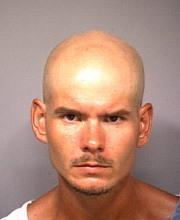
A 28-year-old man in Marion County, Fla., was arrested Tuesday for making up a story that he killed a hitchhiker and dumped his body in the forest in an effort to persuade his wife to leave him, according to police.
Teddy Akin was interviewed by police and admitted the report was false and that he found the wallet at a newspaper box at Nuby's Corner located near Highway 314. He told investigators that he was having problems with his wife and hoped that this story would make her leave him, the report said.
Investigators said Teddy Akin told his wife he killed a man and then dumped the body off east Highway 40.
Akin also told detectives at the Ocala police department that he left the body by the interstate and turned in a wallet belonging to Dennis Allen of Utah.
The Marion County Sheriff's Office began a land and air search of areas around Highway 40 but did not locate a body.
Akin was interviewed again by police and admitted the report was false and that he found the wallet at a newspaper box at Nuby's Corner located near Highway 314.
He told investigators that he was having problems with his wife and hoped that this story would make her leave him, the report said.
Detectives contacted Dennis Allen in Utah who confirmed that he had lost his wallet while visiting Ocala and that he did not know Akin or take a ride with him.
Akin was arrested for filing a false report and theft.
The sheriff's office also said they would probably bill Akin for the cost of their seven-hour search, Capt. Thomas Bibb said.
"This was something that cost us a lot of time and energy," Bibb said.
AND A SPECIAL THIRD-AND-A-HALF STORY
This linked from the story about the guy who made up the bullshit about being a serial killer. It's a little "Girls Gone Wild" for a news station to be sponsoring, right? I ahve to say, I found it all interesting, and so I've decided to compose what I'm too lazy to even bother to laughibly refer to as an investigative report.
Who is the hottest hottie in Central Fllorida?

Several local women are competing for the crown of "Hottest Hottie" and a trip to the MTV Music Awards with Club Paris owners Paris Hilton and Fred Khalilian.
Each Saturday during the broadcast of "Big Brother" on WKMG-TV, Local 6 will eliminate one woman who received the lowest number of votes from online voting and live voting at Club Paris.
The winner will be announced live on Sept. 3 from Club Paris.
Click on the Local 6 slideshow to meet the women and then, click here to vote for your favorite contestant. Voting will also be held a Club Paris on Thursday nights.
The winner will also receive a makeover, a shopping spree and will be named the Club Paris nationwide representative for one year.
 Name: Jessica Bain
Age: 18
Home: Lakeland
Measurements: 34-28-32
Favorite Food: Cheesecake
Favorite type of music: Country and Hip-Hop
Favorite movie: "Billy Madison"
Favorite saying: "If it’s meant to be, it’ll happen."
Career Goal: Real estate agent or Broadcaster.
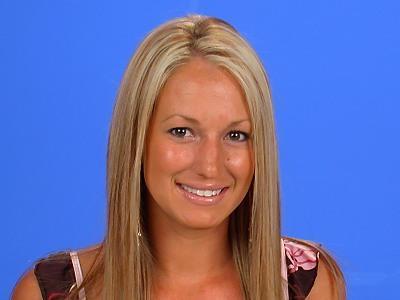 Name: Christina Harrison
Age: 21
Home: Melbourne
Measurements: 34-25-32
Favorite Food: Ice Cream
Favorite type of music: Pop & Techno
Favorite movie: Wedding Crashers
Favorite saying: "What doesn’t break you, only makes you stronger"
Career Goal: Spokesperson for a local company.
 Name: Jessyca Jones
Age: 18
Home: Orlando
Measurements: 36-28-32
Favorite Food: Ice Cream
Favorite type of music: Reggae
Favorite movie: "Billy Madison"
Favorite saying: "Life is short. Live it to the fullest."
Career Goal: Fashion Designer
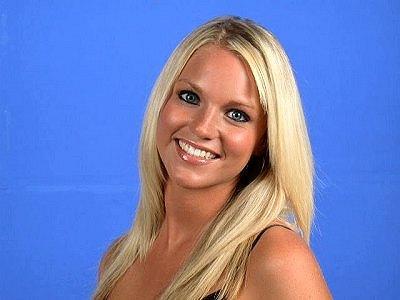 Name: Heather Peters
Age: 19
Home: Orlando
Measurements: 34-28-32
Favorite Food: Spaghetti
Favorite type of music: Rap, R& B, Country
Favorite movie: "Billy Madison"
Favorite saying: "Live the life you love, and love the life you live."
Career Goal: Plastic surgeon or Dermatologist
 Name: Amanda Zitzman
Age: 19
Home: Orlando
Measurements: 32-26-34
Favorite Food: Chicken Quesadilla from Taco Bell
Favorite type of music: Rap
Favorite movie: "Ace Ventura Pet Detective" – Jim Carrey is hilarious!
Favorite saying: "That’s hot!"
Career Goal: I'm a writer and fashion fanatic so I would love to own my own fashion magazine.
Surprisingly, it was not a hard choice. Jessica Bain was the first candidate, and I was immediately taken by her tomboyish attitude and smoker voice. I was intimidated and intrigued. She's really lucky she won me over with the video/,because her answers left me cold. Her best answer was that her favorite music is country and hip hop, which is pretty sad.
Her tape was really the only one I cared for, actually. I'm not just saying that to avoid posting links to the other five tapes. I had hoped to like Heather Peters, because of her desire to be a plastic surgeon or a dermatologist. Likewise, Amanda Zitman had a head start thanks to her literary aspiration, and a phot which suggested interesting, perhaps ethnic, facial characteristics. No luck, they were both doofs. I kind of see this as a low-level political race, in the same spirit as a college stdent government race, perhaps, but with more influence and charm. I was disapppointed there weren't better candidates. And to be really honest, I'm a little wigged out by how similar Christina Harrison and Jessyca James look.
I was going to go back and re-read some of their answers, and make some biting remarks on the state of celebrity culture, the over-commodification of self, and the weird, and probably unearned, sense of class contempt that I wonder if I'm feeling when I read stories about people like this. But it was too depressing to go back. Society's loss.
Currently, Jessica Bain is in fifth place, with 8 percent of the vote.
Wednesday, August 03, 2005

Wednesday, July 27, 2005
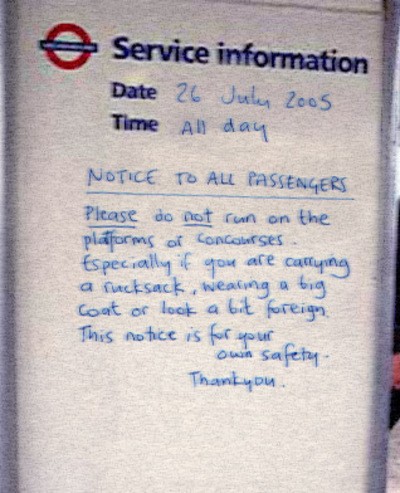
Tuesday, July 26, 2005
I AM FUCKING INSANE
Or am I?
As we close into the end of my birthday, albeit with a few hours to go until we reach the International Date Line, I thought it would be helpful to jot down a prospectus for my mental state for the upcoming year.
Having enjoyed the ups and downs that seem to fgo hand in hand with bipolar disorder (for some reason), I've decided to make the upcoming year of my life one big 365-day "up." For as much as I can control it, at least.
Coming into this year of my life, I'm filled with a sense of purpose.
In an article about Werner Herzog, Roger Ebert referred to Herzog as "messianic." I like that. That's what I want to go for. I want to communicate big ideas -- A Big Idea, even. I'll speak to inspire, or at least to communicate that I am Inspired. The film I'm working on will be a testament, of sorts. A way to empassion the viewers, as well as the actors and crew who work on the film. (I might want to keep that under my hat while I'm making it, otherwise they'll think I'm nuts. It might be enevitable.)
I just need to find it. So that's the purpose. To find purpose and to share with others, in every communication I make. To share my great vision with the world, whatever that vision is. And to do it all the time.
Am I crazy? Crazy to think like this? Posting this here is about as far as I'm willing to go, crazy-wise. Am I losing heart? I don't think so. I was thinking about emailing some close friends, but what's point in that? Better to deomonstrate through my actions. Email everyoen on my list? TOO crazy, I should think.
So now it's to work. What kind of clothes do messianic types wear? White robes? That'd go nice with a dazed expression. Purple? I'd look liek a pimp. A short, fat, Jewish pimp. Google reveals tha messianic color is red. Without realizing it, I just bought TWO red shirts. I'm on my way...
Or am I?
As we close into the end of my birthday, albeit with a few hours to go until we reach the International Date Line, I thought it would be helpful to jot down a prospectus for my mental state for the upcoming year.
Having enjoyed the ups and downs that seem to fgo hand in hand with bipolar disorder (for some reason), I've decided to make the upcoming year of my life one big 365-day "up." For as much as I can control it, at least.
Coming into this year of my life, I'm filled with a sense of purpose.
In an article about Werner Herzog, Roger Ebert referred to Herzog as "messianic." I like that. That's what I want to go for. I want to communicate big ideas -- A Big Idea, even. I'll speak to inspire, or at least to communicate that I am Inspired. The film I'm working on will be a testament, of sorts. A way to empassion the viewers, as well as the actors and crew who work on the film. (I might want to keep that under my hat while I'm making it, otherwise they'll think I'm nuts. It might be enevitable.)
I just need to find it. So that's the purpose. To find purpose and to share with others, in every communication I make. To share my great vision with the world, whatever that vision is. And to do it all the time.
Am I crazy? Crazy to think like this? Posting this here is about as far as I'm willing to go, crazy-wise. Am I losing heart? I don't think so. I was thinking about emailing some close friends, but what's point in that? Better to deomonstrate through my actions. Email everyoen on my list? TOO crazy, I should think.
So now it's to work. What kind of clothes do messianic types wear? White robes? That'd go nice with a dazed expression. Purple? I'd look liek a pimp. A short, fat, Jewish pimp. Google reveals tha messianic color is red. Without realizing it, I just bought TWO red shirts. I'm on my way...

Friday, July 15, 2005
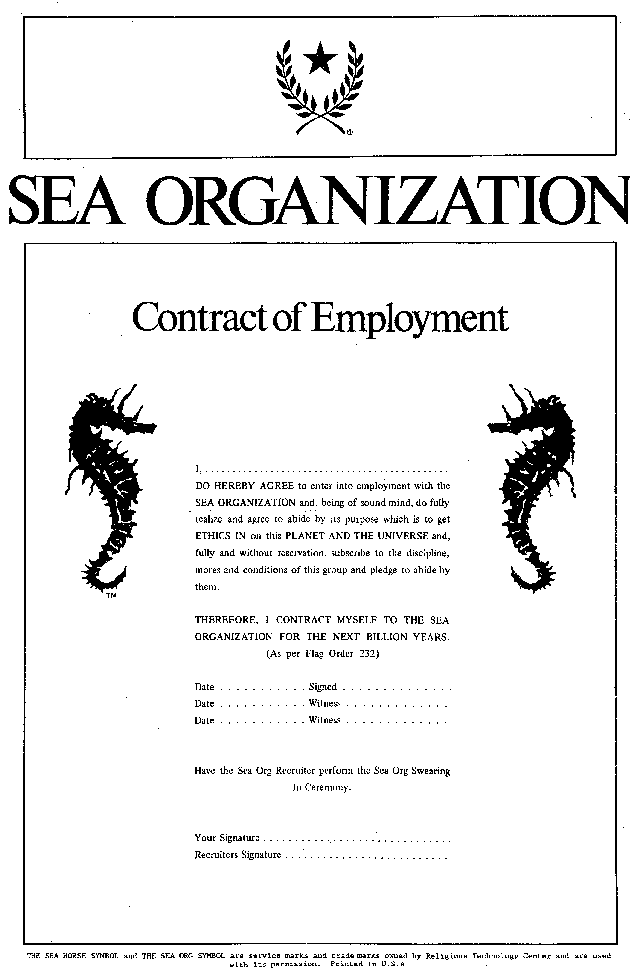
Wednesday, July 13, 2005
Monkey Business
By STEPHEN J. DUBNER and STEVEN D. LEVITT
Keith Chen's Monkey Research
Adam Smith, the founder of classical economics, was certain that humankind's knack for monetary exchange belonged to humankind alone. ''Nobody ever saw a dog make a fair and deliberate exchange of one bone for another with another dog,'' he wrote. ''Nobody ever saw one animal by its gestures and natural cries signify to another, this is mine, that yours; I am willing to give this for that.'' But in a clean and spacious laboratory at Yale-New Haven Hospital, seven capuchin monkeys have been taught to use money, and a comparison of capuchin behavior and human behavior will either surprise you very much or not at all, depending on your view of humans.
The capuchin is a New World monkey, brown and cute, the size of a scrawny year-old human baby plus a long tail. ''The capuchin has a small brain, and it's pretty much focused on food and sex,'' says Keith Chen, a Yale economist who, along with Laurie Santos, a psychologist, is exploiting these natural desires -- well, the desire for food at least -- to teach the capuchins to buy grapes, apples and Jell-O. ''You should really think of a capuchin as a bottomless stomach of want,'' Chen says. ''You can feed them marshmallows all day, they'll throw up and then come back for more.''
When most people think of economics, they probably conjure images of inflation charts or currency rates rather than monkeys and marshmallows. But economics is increasingly being recognized as a science whose statistical tools can be put to work on nearly any aspect of modern life. That's because economics is in essence the study of incentives, and how people -- perhaps even monkeys -- respond to those incentives. A quick scan of the current literature reveals that top economists are studying subjects like prostitution, rock 'n' roll, baseball cards and media bias.
Chen proudly calls himself a behavioral economist, a member of a growing subtribe whose research crosses over into psychology, neuroscience and evolutionary biology. He began his monkey work as a Harvard graduate student, in concert with Marc Hauser, a psychologist. The Harvard monkeys were cotton-top tamarins, and the experiments with them concerned altruism. Two monkeys faced each other in adjoining cages, each equipped with a lever that would release a marshmallow into the other monkey's cage. The only way for one monkey to get a marshmallow was for the other monkey to pull its lever. So pulling the lever was to some degree an act of altruism, or at least of strategic cooperation.
The tamarins were fairly cooperative but still showed a healthy amount of self-interest: over repeated encounters with fellow monkeys, the typical tamarin pulled the lever about 40 percent of the time. Then Hauser and Chen heightened the drama. They conditioned one tamarin to always pull the lever (thus creating an altruistic stooge) and another to never pull the lever (thus creating a selfish jerk). The stooge and the jerk were then sent to play the game with the other tamarins. The stooge blithely pulled her lever over and over, never failing to dump a marshmallow into the other monkey's cage. Initially, the other monkeys responded in kind, pulling their own levers 50 percent of the time. But once they figured out that their partner was a pushover (like a parent who buys her kid a toy on every outing whether the kid is a saint or a devil), their rate of reciprocation dropped to 30 percent -- lower than the original average rate. The selfish jerk, meanwhile, was punished even worse. Once her reputation was established, whenever she was led into the experimenting chamber, the other tamarins ''would just go nuts,'' Chen recalls. ''They'd throw their feces at the wall, walk into the corner and sit on their hands, kind of sulk.''
Chen is a hyperverbal, sharp-dressing 29-year-old with spiky hair. The son of Chinese immigrants, he had an itinerant upbringing in the rural Midwest. As a Stanford undergraduate, he was a de facto Marxist before being seduced, quite accidentally, by economics. He may be the only economist conducting monkey experiments, which puts him at slight odds with his psychologist collaborators (who are more interested in behavior itself than in the incentives that produce the behavior) as well as with certain economist colleagues. ''I love interest rates, and I'm willing to talk about their kind of stuff all the time,'' he says, speaking of his fellow economists. ''But I can tell that they're biting their tongues when I tell them what I'm working on.''
It is sometimes unclear, even to Chen himself, exactly what he is working on. When he and Santos, his psychologist collaborator, began to teach the Yale capuchins to use money, he had no pressing research theme. The essential idea was to give a monkey a dollar and see what it did with it. The currency Chen settled on was a silver disc, one inch in diameter, with a hole in the middle -- ''kind of like Chinese money,'' he says. It took several months of rudimentary repetition to teach the monkeys that these tokens were valuable as a means of exchange for a treat and would be similarly valuable the next day. Having gained that understanding, a capuchin would then be presented with 12 tokens on a tray and have to decide how many to surrender for, say, Jell-O cubes versus grapes. This first step allowed each capuchin to reveal its preferences and to grasp the concept of budgeting.
Then Chen introduced price shocks and wealth shocks. If, for instance, the price of Jell-O fell (two cubes instead of one per token), would the capuchin buy more Jell-O and fewer grapes? The capuchins responded rationally to tests like this -- that is, they responded the way most readers of The Times would respond. In economist-speak, the capuchins adhered to the rules of utility maximization and price theory: when the price of something falls, people tend to buy more of it.
Chen next introduced a pair of gambling games and set out to determine which one the monkeys preferred. In the first game, the capuchin was given one grape and, dependent on a coin flip, either retained the original grape or won a bonus grape. In the second game, the capuchin started out owning the bonus grape and, once again dependent on a coin flip, either kept the two grapes or lost one. These two games are in fact the same gamble, with identical odds, but one is framed as a potential win and the other as a potential loss.
How did the capuchins react? They far preferred to take a gamble on the potential gain than the potential loss. This is not what an economics textbook would predict. The laws of economics state that these two gambles, because they represent such small stakes, should be treated equally.
So, does Chen's gambling experiment simply reveal the cognitive limitations of his small-brained subjects? Perhaps not. In similar experiments, it turns out that humans tend to make the same type of irrational decision at a nearly identical rate. Documenting this phenomenon, known as loss aversion, is what helped the psychologist Daniel Kahneman win a Nobel Prize in economics. The data generated by the capuchin monkeys, Chen says, ''make them statistically indistinguishable from most stock-market investors.''
But do the capuchins actually understand money? Or is Chen simply exploiting their endless appetites to make them perform neat tricks?
Several facts suggest the former. During a recent capuchin experiment that used cucumbers as treats, a research assistant happened to slice the cucumber into discs instead of cubes, as was typical. One capuchin picked up a slice, started to eat it and then ran over to a researcher to see if he could ''buy'' something sweeter with it. To the capuchin, a round slice of cucumber bore enough resemblance to Chen's silver tokens to seem like another piece of currency.
Then there is the stealing. Santos has observed that the monkeys never deliberately save any money, but they do sometimes purloin a token or two during an experiment. All seven monkeys live in a communal main chamber of about 750 cubic feet. For experiments, one capuchin at a time is let into a smaller testing chamber next door. Once, a capuchin in the testing chamber picked up an entire tray of tokens, flung them into the main chamber and then scurried in after them -- a combination jailbreak and bank heist -- which led to a chaotic scene in which the human researchers had to rush into the main chamber and offer food bribes for the tokens, a reinforcement that in effect encouraged more stealing.
Something else happened during that chaotic scene, something that convinced Chen of the monkeys' true grasp of money. Perhaps the most distinguishing characteristic of money, after all, is its fungibility, the fact that it can be used to buy not just food but anything. During the chaos in the monkey cage, Chen saw something out of the corner of his eye that he would later try to play down but in his heart of hearts he knew to be true. What he witnessed was probably the first observed exchange of money for sex in the history of monkeykind. (Further proof that the monkeys truly understood money: the monkey who was paid for sex immediately traded the token in for a grape.)
This is a sensitive subject. The capuchin lab at Yale has been built and maintained to make the monkeys as comfortable as possible, and especially to allow them to carry on in a natural state. The introduction of money was tricky enough; it wouldn't reflect well on anyone involved if the money turned the lab into a brothel. To this end, Chen has taken steps to ensure that future monkey sex at Yale occurs as nature intended it.
But these facts remain: When taught to use money, a group of capuchin monkeys responded quite rationally to simple incentives; responded irrationally to risky gambles; failed to save; stole when they could; used money for food and, on occasion, sex. In other words, they behaved a good bit like the creature that most of Chen's more traditional colleagues study: Homo sapiens.
Stephen J. Dubner and Steven D. Levitt are the authors of ''Freakonomics: A Rogue Economist Explores the Hidden Side of Everything.''
By STEPHEN J. DUBNER and STEVEN D. LEVITT
Keith Chen's Monkey Research
Adam Smith, the founder of classical economics, was certain that humankind's knack for monetary exchange belonged to humankind alone. ''Nobody ever saw a dog make a fair and deliberate exchange of one bone for another with another dog,'' he wrote. ''Nobody ever saw one animal by its gestures and natural cries signify to another, this is mine, that yours; I am willing to give this for that.'' But in a clean and spacious laboratory at Yale-New Haven Hospital, seven capuchin monkeys have been taught to use money, and a comparison of capuchin behavior and human behavior will either surprise you very much or not at all, depending on your view of humans.
The capuchin is a New World monkey, brown and cute, the size of a scrawny year-old human baby plus a long tail. ''The capuchin has a small brain, and it's pretty much focused on food and sex,'' says Keith Chen, a Yale economist who, along with Laurie Santos, a psychologist, is exploiting these natural desires -- well, the desire for food at least -- to teach the capuchins to buy grapes, apples and Jell-O. ''You should really think of a capuchin as a bottomless stomach of want,'' Chen says. ''You can feed them marshmallows all day, they'll throw up and then come back for more.''
When most people think of economics, they probably conjure images of inflation charts or currency rates rather than monkeys and marshmallows. But economics is increasingly being recognized as a science whose statistical tools can be put to work on nearly any aspect of modern life. That's because economics is in essence the study of incentives, and how people -- perhaps even monkeys -- respond to those incentives. A quick scan of the current literature reveals that top economists are studying subjects like prostitution, rock 'n' roll, baseball cards and media bias.
Chen proudly calls himself a behavioral economist, a member of a growing subtribe whose research crosses over into psychology, neuroscience and evolutionary biology. He began his monkey work as a Harvard graduate student, in concert with Marc Hauser, a psychologist. The Harvard monkeys were cotton-top tamarins, and the experiments with them concerned altruism. Two monkeys faced each other in adjoining cages, each equipped with a lever that would release a marshmallow into the other monkey's cage. The only way for one monkey to get a marshmallow was for the other monkey to pull its lever. So pulling the lever was to some degree an act of altruism, or at least of strategic cooperation.
The tamarins were fairly cooperative but still showed a healthy amount of self-interest: over repeated encounters with fellow monkeys, the typical tamarin pulled the lever about 40 percent of the time. Then Hauser and Chen heightened the drama. They conditioned one tamarin to always pull the lever (thus creating an altruistic stooge) and another to never pull the lever (thus creating a selfish jerk). The stooge and the jerk were then sent to play the game with the other tamarins. The stooge blithely pulled her lever over and over, never failing to dump a marshmallow into the other monkey's cage. Initially, the other monkeys responded in kind, pulling their own levers 50 percent of the time. But once they figured out that their partner was a pushover (like a parent who buys her kid a toy on every outing whether the kid is a saint or a devil), their rate of reciprocation dropped to 30 percent -- lower than the original average rate. The selfish jerk, meanwhile, was punished even worse. Once her reputation was established, whenever she was led into the experimenting chamber, the other tamarins ''would just go nuts,'' Chen recalls. ''They'd throw their feces at the wall, walk into the corner and sit on their hands, kind of sulk.''
Chen is a hyperverbal, sharp-dressing 29-year-old with spiky hair. The son of Chinese immigrants, he had an itinerant upbringing in the rural Midwest. As a Stanford undergraduate, he was a de facto Marxist before being seduced, quite accidentally, by economics. He may be the only economist conducting monkey experiments, which puts him at slight odds with his psychologist collaborators (who are more interested in behavior itself than in the incentives that produce the behavior) as well as with certain economist colleagues. ''I love interest rates, and I'm willing to talk about their kind of stuff all the time,'' he says, speaking of his fellow economists. ''But I can tell that they're biting their tongues when I tell them what I'm working on.''
It is sometimes unclear, even to Chen himself, exactly what he is working on. When he and Santos, his psychologist collaborator, began to teach the Yale capuchins to use money, he had no pressing research theme. The essential idea was to give a monkey a dollar and see what it did with it. The currency Chen settled on was a silver disc, one inch in diameter, with a hole in the middle -- ''kind of like Chinese money,'' he says. It took several months of rudimentary repetition to teach the monkeys that these tokens were valuable as a means of exchange for a treat and would be similarly valuable the next day. Having gained that understanding, a capuchin would then be presented with 12 tokens on a tray and have to decide how many to surrender for, say, Jell-O cubes versus grapes. This first step allowed each capuchin to reveal its preferences and to grasp the concept of budgeting.
Then Chen introduced price shocks and wealth shocks. If, for instance, the price of Jell-O fell (two cubes instead of one per token), would the capuchin buy more Jell-O and fewer grapes? The capuchins responded rationally to tests like this -- that is, they responded the way most readers of The Times would respond. In economist-speak, the capuchins adhered to the rules of utility maximization and price theory: when the price of something falls, people tend to buy more of it.
Chen next introduced a pair of gambling games and set out to determine which one the monkeys preferred. In the first game, the capuchin was given one grape and, dependent on a coin flip, either retained the original grape or won a bonus grape. In the second game, the capuchin started out owning the bonus grape and, once again dependent on a coin flip, either kept the two grapes or lost one. These two games are in fact the same gamble, with identical odds, but one is framed as a potential win and the other as a potential loss.
How did the capuchins react? They far preferred to take a gamble on the potential gain than the potential loss. This is not what an economics textbook would predict. The laws of economics state that these two gambles, because they represent such small stakes, should be treated equally.
So, does Chen's gambling experiment simply reveal the cognitive limitations of his small-brained subjects? Perhaps not. In similar experiments, it turns out that humans tend to make the same type of irrational decision at a nearly identical rate. Documenting this phenomenon, known as loss aversion, is what helped the psychologist Daniel Kahneman win a Nobel Prize in economics. The data generated by the capuchin monkeys, Chen says, ''make them statistically indistinguishable from most stock-market investors.''
But do the capuchins actually understand money? Or is Chen simply exploiting their endless appetites to make them perform neat tricks?
Several facts suggest the former. During a recent capuchin experiment that used cucumbers as treats, a research assistant happened to slice the cucumber into discs instead of cubes, as was typical. One capuchin picked up a slice, started to eat it and then ran over to a researcher to see if he could ''buy'' something sweeter with it. To the capuchin, a round slice of cucumber bore enough resemblance to Chen's silver tokens to seem like another piece of currency.
Then there is the stealing. Santos has observed that the monkeys never deliberately save any money, but they do sometimes purloin a token or two during an experiment. All seven monkeys live in a communal main chamber of about 750 cubic feet. For experiments, one capuchin at a time is let into a smaller testing chamber next door. Once, a capuchin in the testing chamber picked up an entire tray of tokens, flung them into the main chamber and then scurried in after them -- a combination jailbreak and bank heist -- which led to a chaotic scene in which the human researchers had to rush into the main chamber and offer food bribes for the tokens, a reinforcement that in effect encouraged more stealing.
Something else happened during that chaotic scene, something that convinced Chen of the monkeys' true grasp of money. Perhaps the most distinguishing characteristic of money, after all, is its fungibility, the fact that it can be used to buy not just food but anything. During the chaos in the monkey cage, Chen saw something out of the corner of his eye that he would later try to play down but in his heart of hearts he knew to be true. What he witnessed was probably the first observed exchange of money for sex in the history of monkeykind. (Further proof that the monkeys truly understood money: the monkey who was paid for sex immediately traded the token in for a grape.)
This is a sensitive subject. The capuchin lab at Yale has been built and maintained to make the monkeys as comfortable as possible, and especially to allow them to carry on in a natural state. The introduction of money was tricky enough; it wouldn't reflect well on anyone involved if the money turned the lab into a brothel. To this end, Chen has taken steps to ensure that future monkey sex at Yale occurs as nature intended it.
But these facts remain: When taught to use money, a group of capuchin monkeys responded quite rationally to simple incentives; responded irrationally to risky gambles; failed to save; stole when they could; used money for food and, on occasion, sex. In other words, they behaved a good bit like the creature that most of Chen's more traditional colleagues study: Homo sapiens.
Stephen J. Dubner and Steven D. Levitt are the authors of ''Freakonomics: A Rogue Economist Explores the Hidden Side of Everything.''
Tuesday, July 12, 2005
ROVE-GATE FOLLIES!
Q: Does the president stand by his pledge to fire anyone involved in a leak of the name of a CIA operative?
MCCLELLAN: I appreciate your question. I think your question is being asked related to some reports that are in reference to an ongoing criminal investigation. The criminal investigation that you reference is something that continues at this point.
And as I’ve previously stated, while that investigation is ongoing, the White House is not going to comment on it.
The president directed the White House to cooperate fully with the investigation. And as part of cooperating fully with the investigation, we made a decision that we weren’t going to comment on it while it is ongoing.
Q: I actually wasn’t talking about any investigation. But in June of 2004, the president said that he would fire anybody who was involved in this leak to the press about information. I just wanted to know: Is that still his position?
MCCLELLAN: Yes, but this question is coming up in the context of this ongoing investigation, and that’s why I said that our policy continues to be that we’re not going to get into commenting on an ongoing criminal investigation from this podium.
The prosecutors overseeing the investigation had expressed a preference to us that one way to help the investigation is not to be commenting on it from this podium....
Q: Scott, if I could point out: Contradictory to that statement, on September 29th of 2003, while the investigation was ongoing, you clearly commented on it. You were the first one to have said that if anybody from the White House was involved, they would be fired. And then, on June 10th of 2004, at Sea Island Plantation, in the midst of this investigation, when the president made his comments that, yes, he would fire anybody from the White House who was involved. So why have you commented on this during the process of the investigation in the past, but now you’ve suddenly drawn a curtain around it under the statement of, 'We’re not going to comment on an ongoing investigation'?
MCCLELLAN: Again, John, I appreciate the question. I know you want to get to the bottom of this. No one wants to get to the bottom of it more than the president of the United States. And I think the way to be most helpful is to not get into commenting on it while it is an ongoing investigation. And that’s something that the people overseeing the investigation have expressed a preference that we follow.
And that’s why we’re continuing to follow that approach and that policy. Now, I remember very well what was previously said. And, at some point, I will be glad to talk about it, but not until after the investigation is complete.
Q: So could I just ask: When did you change your mind to say that it was OK to comment during the course of an investigation before, but now it’s not?
MCCLELLAN: Well, I think maybe you missed what I was saying in reference to Terry’s question at the beginning. There came a point, when the investigation got under way, when those overseeing the investigation asked that it would be — or said that it would be their preference that we not get into discussing it while it is ongoing.
I think that’s the way to be most helpful to help them advance the investigation and get to the bottom of it.
Q: Scott, can I ask you this: Did Karl Rove commit a crime?
MCCLELLAN: Again, David, this is a question relating to a ongoing investigation, and you have my response related to the investigation. And I don't think you should read anything into it other than: We're going to continue not to comment on it while it's ongoing.
Q: Do you stand by your statement from the fall of 2003, when you were asked specifically about Karl and Elliot Abrams and Scooter Libby, and you said, "I've gone to each of those gentlemen, and they have told me they are not involved in this"?
MCCLELLAN: And if you will recall, I said that, as part of helping the investigators move forward on the investigation, we're not going to get into commenting on it. That was something I stated back near that time as well.
Q: Scott, this is ridiculous. The notion that you're going to stand before us, after having commented with that level of detail, and tell people watching this that somehow you've decided not to talk. You've got a public record out there. Do you stand by your remarks from that podium or not?
MCCLELLAN: I'm well aware, like you, of what was previously said. And I will be glad to talk about it at the appropriate time. The appropriate time is when the investigation...
Q: (inaudible) when it's appropriate and when it's inappropriate?
MCCLELLAN: If you'll let me finish.
Q: No, you're not finishing. You're not saying anything. You stood at that podium and said that Karl Rove was not involved. And now we find out that he spoke about Joseph Wilson's wife. So don't you owe the American public a fuller explanation. Was he involved or was he not? Because contrary to what you told the American people, he did indeed talk about his wife, didn't he?
MCCLELLAN: There will be a time to talk about this, but now is not the time to talk about it.
Q: Do you think people will accept that, what you're saying today?
MCCLELLAN: Again, I've responded to the question.
QUESTION: You're in a bad spot here, Scott... because after the investigation began -- after the criminal investigation was under way -- you said, October 10th, 2003, "I spoke with those individuals, Rove, Abrams and Libby. As I pointed out, those individuals assured me they were not involved in this," from that podium. That's after the criminal investigation began.
Now that Rove has essentially been caught red-handed peddling this information, all of a sudden you have respect for the sanctity of the criminal investigation?
MCCLELLAN: No, that's not a correct characterization. And I think you are well aware of that.....
And we want to be helpful so that they can get to the bottom of this. Because no one wants to get to the bottom of it more than the president of the United States.
I am well aware of what was said previously. I remember well what was said previously. And at some point I look forward to talking about it. But until the investigation is complete, I'm just not going to do that.
Q: So you're now saying that after you cleared Rove and the others from that podium, then the prosecutors asked you not to speak anymore and since then you haven't.
MCCLELLAN: Again, you're continuing to ask questions relating to an ongoing criminal investigation and I'm just not going to respond to them.
Q: When did they ask you to stop commenting on it, Scott? Can you pin down a date?
MCCLELLAN: Back in that time period.
Q: Well, then the president commented on it nine months later. So was he not following the White House plan?
MCCLELLAN: I appreciate your questions. You can keep asking them, but you have my response.
Q: Well, we are going to keep asking them. When did the president learn that Karl Rove had had a conversation with a news reporter about the involvement of Joseph Wilson's wife in the decision to send him to Africa?
MCCLELLAN: I've responded to the questions.
Q: When did the president learn that Karl Rove had been...
MCCLELLAN: I've responded to your questions.
Q: After the investigation is completed, will you then be consistent with your word and the president's word that anybody who was involved will be let go?
MCCLELLAN: Again, after the investigation is complete, I will be glad to talk about it at that point.
Q: Can you walk us through why, given the fact that Rove's lawyer has spoken publicly about this, it is inconsistent with the investigation, that it compromises the investigation to talk about the involvement of Karl Rove, the deputy chief of staff, here?
MCCLELLAN: Well, those overseeing the investigation expressed a preference to us that we not get into commenting on the investigation while it's ongoing. And that was what they requested of the White House. And so I think in order to be helpful to that investigation, we are following their direction.
Q: Does the president continue to have confidence in Mr. Rove?
MCCLELLAN: Again, these are all questions coming up in the context of an ongoing criminal investigation. And you've heard my response on this.
Q: So you're not going to respond as to whether or not the president has confidence in his deputy chief of staff?
MCCLELLAN: You're asking this question in the context of an ongoing investigation, and I would not read anything into it other then I'm simply going to comment on an ongoing investigation.
Q: Has there been any change, or is there a plan for Mr. Rove's portfolio to be altered in any way?
MCCLELLAN: Again, you have my response to these questions....
***
Q: There’s a difference between commenting publicly on an action and taking action in response to it. Newsweek put out a story, an e-mail saying that Karl Rove passed national security information on to a reporter that outed a CIA officer. Now, are you saying that the president is not taking any action in response to that? Because I presume that the prosecutor did not ask you not to take action and that if he did you still would not necessarily abide by that; that the president is free to respond to news reports, regardless of whether there’s an investigation or not.
So are you saying that he’s not going to do anything about this until the investigation is fully over and done with?
MCCLELLAN: Well, I think the president has previously spoken to this.
This continues to be an ongoing criminal investigation. No one wants to get to the bottom of it more than the president of the United States. And we’re just not going to have more to say on it until that investigation is complete.
***
Q: When the leak investigation is completed, does the president believe it might be important for his credibility, the credibility of the White House, to release all the information voluntarily that was submitted as part of the investigation, so the American public could see what transpired inside the White House at the time?
MCCLELLAN: This is an investigation being overseen by a special prosecutor. And I think those are questions best directed to the special prosecutor.
Q: Have you or the White House considered whether that would be optimal to release as much information and make it as open…
MCCLELLAN: It’s the same type of question. You’re asking me to comment on an ongoing investigation and I’m not going to do that.
Q: I’d like you to talk about the communications strategies just a little bit there.
MCCLELLAN: Understood. The president directed the White House to cooperate fully with the investigation, and that’s what he expects people in the White House to do.
Q: And he would like to do that when it is concluded, cooperate fully with…
MCCLELLAN: Again, I’ve already responded.
Q: Scott, who in the investigation made this request of the White House not to comment further about the investigation? Was it Mr. Fitzgerald? Did he make a request of you specifically?
MCCLELLAN: You can direct those questions to the special prosecutors. I think probably more than one individual who’s involved in overseeing the investigation had expressed a preference that we not get into commenting on the investigation while it’s ongoing.
Q: Does the president stand by his pledge to fire anyone involved in a leak of the name of a CIA operative?
MCCLELLAN: I appreciate your question. I think your question is being asked related to some reports that are in reference to an ongoing criminal investigation. The criminal investigation that you reference is something that continues at this point.
And as I’ve previously stated, while that investigation is ongoing, the White House is not going to comment on it.
The president directed the White House to cooperate fully with the investigation. And as part of cooperating fully with the investigation, we made a decision that we weren’t going to comment on it while it is ongoing.
Q: I actually wasn’t talking about any investigation. But in June of 2004, the president said that he would fire anybody who was involved in this leak to the press about information. I just wanted to know: Is that still his position?
MCCLELLAN: Yes, but this question is coming up in the context of this ongoing investigation, and that’s why I said that our policy continues to be that we’re not going to get into commenting on an ongoing criminal investigation from this podium.
The prosecutors overseeing the investigation had expressed a preference to us that one way to help the investigation is not to be commenting on it from this podium....
Q: Scott, if I could point out: Contradictory to that statement, on September 29th of 2003, while the investigation was ongoing, you clearly commented on it. You were the first one to have said that if anybody from the White House was involved, they would be fired. And then, on June 10th of 2004, at Sea Island Plantation, in the midst of this investigation, when the president made his comments that, yes, he would fire anybody from the White House who was involved. So why have you commented on this during the process of the investigation in the past, but now you’ve suddenly drawn a curtain around it under the statement of, 'We’re not going to comment on an ongoing investigation'?
MCCLELLAN: Again, John, I appreciate the question. I know you want to get to the bottom of this. No one wants to get to the bottom of it more than the president of the United States. And I think the way to be most helpful is to not get into commenting on it while it is an ongoing investigation. And that’s something that the people overseeing the investigation have expressed a preference that we follow.
And that’s why we’re continuing to follow that approach and that policy. Now, I remember very well what was previously said. And, at some point, I will be glad to talk about it, but not until after the investigation is complete.
Q: So could I just ask: When did you change your mind to say that it was OK to comment during the course of an investigation before, but now it’s not?
MCCLELLAN: Well, I think maybe you missed what I was saying in reference to Terry’s question at the beginning. There came a point, when the investigation got under way, when those overseeing the investigation asked that it would be — or said that it would be their preference that we not get into discussing it while it is ongoing.
I think that’s the way to be most helpful to help them advance the investigation and get to the bottom of it.
Q: Scott, can I ask you this: Did Karl Rove commit a crime?
MCCLELLAN: Again, David, this is a question relating to a ongoing investigation, and you have my response related to the investigation. And I don't think you should read anything into it other than: We're going to continue not to comment on it while it's ongoing.
Q: Do you stand by your statement from the fall of 2003, when you were asked specifically about Karl and Elliot Abrams and Scooter Libby, and you said, "I've gone to each of those gentlemen, and they have told me they are not involved in this"?
MCCLELLAN: And if you will recall, I said that, as part of helping the investigators move forward on the investigation, we're not going to get into commenting on it. That was something I stated back near that time as well.
Q: Scott, this is ridiculous. The notion that you're going to stand before us, after having commented with that level of detail, and tell people watching this that somehow you've decided not to talk. You've got a public record out there. Do you stand by your remarks from that podium or not?
MCCLELLAN: I'm well aware, like you, of what was previously said. And I will be glad to talk about it at the appropriate time. The appropriate time is when the investigation...
Q: (inaudible) when it's appropriate and when it's inappropriate?
MCCLELLAN: If you'll let me finish.
Q: No, you're not finishing. You're not saying anything. You stood at that podium and said that Karl Rove was not involved. And now we find out that he spoke about Joseph Wilson's wife. So don't you owe the American public a fuller explanation. Was he involved or was he not? Because contrary to what you told the American people, he did indeed talk about his wife, didn't he?
MCCLELLAN: There will be a time to talk about this, but now is not the time to talk about it.
Q: Do you think people will accept that, what you're saying today?
MCCLELLAN: Again, I've responded to the question.
QUESTION: You're in a bad spot here, Scott... because after the investigation began -- after the criminal investigation was under way -- you said, October 10th, 2003, "I spoke with those individuals, Rove, Abrams and Libby. As I pointed out, those individuals assured me they were not involved in this," from that podium. That's after the criminal investigation began.
Now that Rove has essentially been caught red-handed peddling this information, all of a sudden you have respect for the sanctity of the criminal investigation?
MCCLELLAN: No, that's not a correct characterization. And I think you are well aware of that.....
And we want to be helpful so that they can get to the bottom of this. Because no one wants to get to the bottom of it more than the president of the United States.
I am well aware of what was said previously. I remember well what was said previously. And at some point I look forward to talking about it. But until the investigation is complete, I'm just not going to do that.
Q: So you're now saying that after you cleared Rove and the others from that podium, then the prosecutors asked you not to speak anymore and since then you haven't.
MCCLELLAN: Again, you're continuing to ask questions relating to an ongoing criminal investigation and I'm just not going to respond to them.
Q: When did they ask you to stop commenting on it, Scott? Can you pin down a date?
MCCLELLAN: Back in that time period.
Q: Well, then the president commented on it nine months later. So was he not following the White House plan?
MCCLELLAN: I appreciate your questions. You can keep asking them, but you have my response.
Q: Well, we are going to keep asking them. When did the president learn that Karl Rove had had a conversation with a news reporter about the involvement of Joseph Wilson's wife in the decision to send him to Africa?
MCCLELLAN: I've responded to the questions.
Q: When did the president learn that Karl Rove had been...
MCCLELLAN: I've responded to your questions.
Q: After the investigation is completed, will you then be consistent with your word and the president's word that anybody who was involved will be let go?
MCCLELLAN: Again, after the investigation is complete, I will be glad to talk about it at that point.
Q: Can you walk us through why, given the fact that Rove's lawyer has spoken publicly about this, it is inconsistent with the investigation, that it compromises the investigation to talk about the involvement of Karl Rove, the deputy chief of staff, here?
MCCLELLAN: Well, those overseeing the investigation expressed a preference to us that we not get into commenting on the investigation while it's ongoing. And that was what they requested of the White House. And so I think in order to be helpful to that investigation, we are following their direction.
Q: Does the president continue to have confidence in Mr. Rove?
MCCLELLAN: Again, these are all questions coming up in the context of an ongoing criminal investigation. And you've heard my response on this.
Q: So you're not going to respond as to whether or not the president has confidence in his deputy chief of staff?
MCCLELLAN: You're asking this question in the context of an ongoing investigation, and I would not read anything into it other then I'm simply going to comment on an ongoing investigation.
Q: Has there been any change, or is there a plan for Mr. Rove's portfolio to be altered in any way?
MCCLELLAN: Again, you have my response to these questions....
***
Q: There’s a difference between commenting publicly on an action and taking action in response to it. Newsweek put out a story, an e-mail saying that Karl Rove passed national security information on to a reporter that outed a CIA officer. Now, are you saying that the president is not taking any action in response to that? Because I presume that the prosecutor did not ask you not to take action and that if he did you still would not necessarily abide by that; that the president is free to respond to news reports, regardless of whether there’s an investigation or not.
So are you saying that he’s not going to do anything about this until the investigation is fully over and done with?
MCCLELLAN: Well, I think the president has previously spoken to this.
This continues to be an ongoing criminal investigation. No one wants to get to the bottom of it more than the president of the United States. And we’re just not going to have more to say on it until that investigation is complete.
***
Q: When the leak investigation is completed, does the president believe it might be important for his credibility, the credibility of the White House, to release all the information voluntarily that was submitted as part of the investigation, so the American public could see what transpired inside the White House at the time?
MCCLELLAN: This is an investigation being overseen by a special prosecutor. And I think those are questions best directed to the special prosecutor.
Q: Have you or the White House considered whether that would be optimal to release as much information and make it as open…
MCCLELLAN: It’s the same type of question. You’re asking me to comment on an ongoing investigation and I’m not going to do that.
Q: I’d like you to talk about the communications strategies just a little bit there.
MCCLELLAN: Understood. The president directed the White House to cooperate fully with the investigation, and that’s what he expects people in the White House to do.
Q: And he would like to do that when it is concluded, cooperate fully with…
MCCLELLAN: Again, I’ve already responded.
Q: Scott, who in the investigation made this request of the White House not to comment further about the investigation? Was it Mr. Fitzgerald? Did he make a request of you specifically?
MCCLELLAN: You can direct those questions to the special prosecutors. I think probably more than one individual who’s involved in overseeing the investigation had expressed a preference that we not get into commenting on the investigation while it’s ongoing.
Friday, July 08, 2005
I'M A WINNER!!!
Just got the following email...
Dear Before Sunset Fan:
Congratulations! You have been chosen as a Grand Prize winner of the “Warner Independent Pictures Before Sunset Member Giveaway” sponsored by Warner Bros. Online.
You have won the following:
One (1) autographed copy of the screenplay from the Warner Independent Pictures feature, “Before Sunset”
One copy of the “Before Sunrise” DVD
One copy of the “Before Sunset” DVD
All prizing will be mailed to the address you provided at time of entry. Delivery takes approximately 6-8 weeks.
We hope that you enjoy your prize! Don’t forget to check www.warnerbros.com for new and exciting sweepstakes!
Sincerely,
Warner Bros. Online Prize Fulfillment Team
This is the first time I've won anything since that size small "Dancer in the Dark" t-shirt a few years ago. Oh, and all those tools from my assistant's dance fundraiser last month.
Bask in my full life! In your face, losers!
Just got the following email...
Dear Before Sunset Fan:
Congratulations! You have been chosen as a Grand Prize winner of the “Warner Independent Pictures Before Sunset Member Giveaway” sponsored by Warner Bros. Online.
You have won the following:
One (1) autographed copy of the screenplay from the Warner Independent Pictures feature, “Before Sunset”
One copy of the “Before Sunrise” DVD
One copy of the “Before Sunset” DVD
All prizing will be mailed to the address you provided at time of entry. Delivery takes approximately 6-8 weeks.
We hope that you enjoy your prize! Don’t forget to check www.warnerbros.com for new and exciting sweepstakes!
Sincerely,
Warner Bros. Online Prize Fulfillment Team
This is the first time I've won anything since that size small "Dancer in the Dark" t-shirt a few years ago. Oh, and all those tools from my assistant's dance fundraiser last month.
Bask in my full life! In your face, losers!
Man Lights Himself on Fire to Propose

GRANTS PASS, Ore. - To prove his love, a 38-year-old man set himself on fire before getting down on one knee and asking his girlfriend to marry him.
About 100 people gathered to watch Todd Grannis perform the flaming stunt on Monday, which involved wearing a cape soaked in gasoline.
Grannis climbed up a 10-foot scaffold, was set on fire and then plunged into a swimming pool, dousing the blaze. Emerging unscathed, he got down on one knee and proposed, as a friend standing nearby slipped him the engagement ring.
"Honey, you make me hot," he told his sweetheart, Malissa Kusiek. "I hope I'm getting the point across that I'm on fire for you."
Kusiek, who has been dating Grannis for several years, said "yes," but added that she was a little angry because of the danger.
"At first I was mad, because I thought, 'He's not a stuntman,'" Kusiek said. "Then, of course, the tears started flowing. Of course I said yes. I was so thrilled."
Grannis said he came up with the stunt through the help of his friend, professional stuntman Eric Barkey. Barkey pulled out a photo of himself on fire and said, "You could do that," Grannis said.
Grannis met Kusiek, the owner of a local hair salon, when she cut his hair.
"I kept telling her sometime before I'm 50," said Grannis, who co-owns an Internet wholesale company. "She wasn't expecting it. She had no clue."
GRANTS PASS, Ore. - To prove his love, a 38-year-old man set himself on fire before getting down on one knee and asking his girlfriend to marry him.
About 100 people gathered to watch Todd Grannis perform the flaming stunt on Monday, which involved wearing a cape soaked in gasoline.
Grannis climbed up a 10-foot scaffold, was set on fire and then plunged into a swimming pool, dousing the blaze. Emerging unscathed, he got down on one knee and proposed, as a friend standing nearby slipped him the engagement ring.
"Honey, you make me hot," he told his sweetheart, Malissa Kusiek. "I hope I'm getting the point across that I'm on fire for you."
Kusiek, who has been dating Grannis for several years, said "yes," but added that she was a little angry because of the danger.
"At first I was mad, because I thought, 'He's not a stuntman,'" Kusiek said. "Then, of course, the tears started flowing. Of course I said yes. I was so thrilled."
Grannis said he came up with the stunt through the help of his friend, professional stuntman Eric Barkey. Barkey pulled out a photo of himself on fire and said, "You could do that," Grannis said.
Grannis met Kusiek, the owner of a local hair salon, when she cut his hair.
"I kept telling her sometime before I'm 50," said Grannis, who co-owns an Internet wholesale company. "She wasn't expecting it. She had no clue."
Wednesday, July 06, 2005
TOO MUCH INFORMATION?
Don't ask why I was reading an online bio of Supreme Court Justice Bajamin Cardozo, but I was struck by this tidbit in the second-to-last paragraph: "As far as is known, Benjamin Cardozo led the life of a celibate." And I always assumed that being known as a "bachelor" in the history books meant one was gay. I hope when I go, history's gossip about my personal life will be a little less bleak than that.
Don't ask why I was reading an online bio of Supreme Court Justice Bajamin Cardozo, but I was struck by this tidbit in the second-to-last paragraph: "As far as is known, Benjamin Cardozo led the life of a celibate." And I always assumed that being known as a "bachelor" in the history books meant one was gay. I hope when I go, history's gossip about my personal life will be a little less bleak than that.
Republicans. Unconciousness. Sodomy. It doesn't get any better than this.
Dr. Hager's Family Values
by AYELISH MCGARVEY
[from the Nation, May 30, 2005 issue]
Late last October Dr. W. David Hager, a prominent obstetrician-gynecologist and Bush Administration appointee to the Advisory Committee for Reproductive Health Drugs in the Food and Drug Administration (FDA), took to the pulpit as the featured speaker at a morning service. He stood in the campus chapel at Asbury College, a small evangelical Christian school nestled among picturesque horse farms in the small town of Wilmore in Kentucky's bluegrass region. Hager is an Asburian nabob; his elderly father is a past president of the college, and Hager himself currently sits on his alma mater's board of trustees. Even the school's administrative building, Hager Hall, bears the family name.
That day, a mostly friendly audience of 1,500 students and faculty packed into the seats in front of him. With the autumn sunlight streaming through the stained-glass windows, Hager opened his Bible to the Old Testament Book of Ezekiel and looked out into the audience. "I want to share with you some information about how...God has called me to stand in the gap," he declared. "Not only for others, but regarding ethical and moral issues in our country."
For Hager, those moral and ethical issues all appear to revolve around sex: In both his medical practice and his advisory role at the FDA, his ardent evangelical piety anchors his staunch opposition to emergency contraception, abortion and premarital sex. Through his six books--which include such titles as Stress and the Woman's Body and As Jesus Cared for Women, self-help tomes that interweave syrupy Christian spirituality with paternalistic advice on women's health and relationships--he has established himself as a leading conservative Christian voice on women's health and sexuality.
And because of his warm relationship with the Bush Administration, Hager has had the opportunity to see his ideas influence federal policy. In December 2003 the FDA advisory committee of which he is a member was asked to consider whether emergency contraception, known as Plan B, should be made available over the counter. Over Hager's dissent, the committee voted overwhelmingly to approve the change. But the FDA rejected its recommendation, a highly unusual and controversial decision in which Hager, The Nation has learned, played a key role. Hager's reappointment to the committee, which does not require Congressional approval, is expected this June, but Bush's nomination of Dr. Lester Crawford as FDA director has been bogged down in controversy over the issue of emergency contraception. Crawford was acting director throughout the Plan B debacle, and Senate Democrats, led by Hillary Clinton and Patty Murray, are holding up his nomination until the agency revisits its decision about going over the counter with the pill.
When Hager's nomination to the FDA was announced in the fall of 2002, his conservative Christian beliefs drew sharp criticism from Democrats and prochoice groups. David Limbaugh, the lesser light in the Limbaugh family and author of Persecution: How Liberals Are Waging Political War Against Christianity, said the left had subjected Hager to an "anti-Christian litmus test." Hager's valor in the face of this "religious profiling" earned him the praise and lasting support of evangelical Christians, including such luminaries as Charles Colson, Dr. James Dobson and Franklin Graham, son of the Rev. Billy Graham.
Back at Asbury, Hager cast himself as a victim of religious persecution in his sermon. "You see...there is a war going on in this country," he said gravely. "And I'm not speaking about the war in Iraq. It's a war being waged against Christians, particularly evangelical Christians. It wasn't my scientific record that came under scrutiny [at the FDA]. It was my faith.... By making myself available, God has used me to stand in the breach.... Just as he has used me, he can use you."
Up on the dais, several men seated behind Hager nodded solemnly in agreement. But out in the audience, Linda Carruth Davis--co-author with Hager of Stress and the Woman's Body, and, more saliently, his former wife of thirty-two years--was enraged. "It was the most disgusting thing I've ever heard," she recalled months later, through clenched teeth.
According to Davis, Hager's public moralizing on sexual matters clashed with his deplorable treatment of her during their marriage. Davis alleges that between 1995 and their divorce in 2002, Hager repeatedly sodomized her without her consent. Several sources on and off the record confirmed that she had told them it was the sexual and emotional abuse within their marriage that eventually forced her out. "I probably wouldn't have objected so much, or felt it was so abusive if he had just wanted normal [vaginal] sex all the time," she explained to me. "But it was the painful, invasive, totally nonconsensual nature of the [anal] sex that was so horrible."
Not once during the uproar over Hager's FDA appointment did any reporter solicit the opinion of the woman now known as Linda Davis--she remarried in November 2002 to James Davis, a Methodist minister, and relocated to southern Georgia--on her husband's record, even though she contributed to much of his self-help work in the Christian arena (she remains a religious and political conservative). She intermittently thought of telling her story but refrained, she says, out of respect for her adult children. It was Hager's sermon at Asbury last October that finally changed her mind. Davis was there to hear her middle son give a vocal performance; she was prepared to hear her ex-husband inveigh against secular liberals, but she was shocked to hear him speak about their divorce when he took to the pulpit.
"In early 2002," Hager told the churchgoers that day, "my world fell apart.... After thirty-two years of marriage, I was suddenly alone in a new home that we had built as our dream home. Time spent 'doing God's will' had kept me from spending the time I needed to nourish my marriage." Hager noted with pride that in his darkest hour, Focus on the Family estimated that 50 million people worldwide were praying for him.
Linda Davis quietly fumed in her chair. "He had the gall to stand under the banner of holiness of the Lord and lie, by the sin of omission," she told me. "It's what he didn't say--it's the impression he left."
David Hager is not the fringe character and fundamentalist faith healer that some of his critics have made him out to be. In fact, he is a well-credentialed doctor. In Kentucky Hager has long been recognized as a leading Ob-Gyn at Lexington's Central Baptist Hospital and a faculty member at the University of Kentucky's medical school. And in the 1990s several magazines, including Modern Healthcare and Good Housekeeping, counted him among the best doctors for women in the nation.
Yet while Hager doesn't advocate the substitution of conservative Christianity for medicine, his religious ideology underlies an all-encompassing paternalism in his approach to his women patients. "Even though I was trained as a medical specialist," Hager explained in the preface to As Jesus Cared for Women, "it wasn't until I began to see how Jesus treated women that I understood how I, as a doctor, should treat them." To underscore this revelation, Hager recounted case after case in which he acted as confidant, spiritual adviser and even father figure to his grateful patients. As laid out in his writings, Hager's worldview is not informed by a sense of inherent equality between men and women. Instead, men are expected to act as benevolent authority figures for the women in their lives. (In one of his books, he refers to a man who raped his wife as "selfish" and "sinful.") But to model gender relations on the one Jesus had with his followers is to leave women dangerously exposed in the event that the men in their lives don't meet the high standard set by God Himself--trapped in a permanent state of dependence hoping to be treated well.
In tandem with his medical career, Hager has been an aggressive advocate for the political agenda of the Christian right. A member of Focus on the Family's Physician Resource Council and the Christian Medical and Dental Society, Hager assisted the Concerned Women for America in submitting a "Citizen's Petition" to the FDA in August 2002 to halt distribution and marketing of the abortion pill, RU-486. It was this record of conservative activism that ignited a firestorm when the Bush Administration first floated his name for chairman of the FDA's advisory committee in the fall of 2002. In the end, the FDA found a way to dodge the controversy: It issued a stealth announcement of Hager's appointment to the panel (to be one of eleven members, not chairman) on Christmas Eve. Liberals were furious that they weren't able to block his appointment. For many months afterward, an outraged chain letter alerting women to the appointment of a man with religious views "far outside the mainstream" snaked its way around the Internet, lending the whole episode the air of urban legend.
Back in Lexington, where the couple continued to live, Linda Hager, as she was still known at the time, was sinking into a deep depression, she says. Though her marriage had been dead for nearly a decade, she could not see her way clear to divorce; she had no money of her own and few marketable skills. But life with David Hager had grown unbearable. As his public profile increased, so did the tension in their home, which she says periodically triggered episodes of abuse. "I would be asleep," she recalls, "and since [the sodomy] was painful and threatening, I woke up. Sometimes I acquiesced once he had started, just to make it go faster, and sometimes I tried to push him off.... I would [confront] David later, and he would say, 'You asked me to do that,' and I would say, 'No, I never asked for it.'"
I first heard of Davis's experience in 2004 through a friend of hers. After a few telephone conversations, she agreed to have me fly down to see her in her modest parsonage in Georgia, to tell me her story on the record. With her mod reading glasses, stylish bob and clever outfits, Davis, 55, is a handsome woman with a sharp wit. She spoke with me over two days in January.
Linda Davis (née Carruth) first met David Hager on the campus of Asbury College in 1967. "On the very first date he sat me down and told me he was going to marry me," Davis remembers. "I was so overwhelmed by this aggressive approach of 'I see you and I want you' that I was completely seduced by it."
Davis, a former beauty queen, was a disengaged student eager to get married and start a family. A Hager-Carruth marriage promised prestige and wealth for the couple; her father was a famous Methodist evangelist, and his father was then president of Asbury. "On the surface, it just looked so good," she remembers. The couple married in 1970, while Hager completed medical school at the University of Kentucky.
"I don't think I was married even a full year before I realized that I had made a horrible mistake," Davis says. By her account, Hager was demanding and controlling, and the couple shared little emotional intimacy. "But," she says, "the people around me said, 'Well, you've made your bed, and now you have to lie in it.'" So Davis commenced with family making and bore three sons: Philip, in 1973; Neal, in 1977; and Jonathan, in 1979.
Sometime between the births of Neal and Jonathan, Hager embarked on an affair with a Bible-study classmate who was a friend of Davis's. A close friend of Davis's remembers her calling long distance when she found out: "She was angry and distraught, like any woman with two children would be. But she was committed to working it out."
Sex was always a source of conflict in the marriage. Though it wasn't emotionally satisfying for her, Davis says she soon learned that sex could "buy" peace with Hager after a long day of arguing, or insure his forgiveness after she spent too much money. "Sex was coinage; it was a commodity," she said. Sometimes Hager would blithely shift from vaginal to anal sex. Davis protested. "He would say, 'Oh, I didn't mean to have anal sex with you; I can't feel the difference,'" Davis recalls incredulously. "And I would say, 'Well then, you're in the wrong business.'"
By the 1980s, according to Davis, Hager was pressuring her to let him videotape and photograph them having sex. She consented, and eventually she even let Hager pay her for sex that she wouldn't have otherwise engaged in--for example, $2,000 for oral sex, "though that didn't happen very often because I hated doing it so much. So though it was more painful, I would let him sodomize me, and he would leave a check on the dresser," Davis admitted to me with some embarrassment. This exchange took place almost weekly for several years.
Money was an explosive issue in their household. Hager kept an iron grip on the family purse strings. Initially the couple's single checking account was in Hager's name only, which meant that Davis had to appeal to her husband for cash, she says. Eventually he relented and opened a dual account. Davis recalls that Hager would return home every evening and make a beeline for his office to balance the checkbook, often angrily summoning her to account for the money she'd spent that day. Brenda Bartella Peterson, Davis's friend of twenty-five years and her neighbor at the time, witnessed Hager berate his wife in their kitchen after one such episode. For her part, Davis set out to subvert Hager's financial dominance with profligate spending on credit cards opened in her own name. "I was not willing to face reality about money," she admits. "I thought, 'Well, money can't buy happiness, but it buys the kind of misery you can learn to live with.'"
These financial atmospherics undoubtedly figured into Linda's willingness to accept payment for sex. But eventually her conscience caught up with her. "Finally...I said, 'You know, David, this is like being a prostitute. I just can't do this anymore; I don't think it's healthy for our relationship,'" she recalls.
By 1995, according to Davis's account, Hager's treatment of his wife had moved beyond morally reprehensible to potentially felonious. It was a uniquely stressful year for Davis. Her mother, dying of cancer, had moved in with the family and was in need of constant care. At the same time, Davis was suffering from a seemingly inexplicable exhaustion during the day. She began exhibiting a series of strange behaviors, like falling asleep in such curious places as the mall and her closet. Occasionally she would--as she describes it--"zone out" in midsentence in a conversation, and her legs would buckle. Eventually, Davis was diagnosed as having narcolepsy, a neurological disorder that affects the brain's ability to regulate normal sleep-wake cycles.
For Davis, the diagnosis spelled relief, and a physician placed her on several medications to attain "sleep hygiene," or a consistent sleep pattern. But Davis says it was after the diagnosis that the period of the most severe abuse began. For the next seven years Hager sodomized Davis without her consent while she slept roughly once a month until their divorce in 2002, she claims. "My sense is that he saw [my narcolepsy] as an opportunity," Davis surmises. Sometimes she fought Hager off and he would quit for a while, only to circle back later that same night; at other times, "the most expedient thing was to try and somehow get it [over with]. In order to keep any peace, I had to maintain the illusion of being available to him." At still other moments, she says, she attempted to avoid Hager's predatory advances in various ways--for example, by sleeping in other rooms in the house, or by struggling to stay awake until Hager was in a deep sleep himself. But, she says, nothing worked. One of Davis's lifelong confidantes remembers when Davis first told her about the abuse. "[Linda] was very angry and shaken," she recalled.
As Hager began fielding calls from the White House personnel office in 2001, the stress in the household--and, with it, the abuse--hit an all-time high, according to Davis. She says she confronted her husband on numerous occasions: "[I said to him,] 'Every time you do this, I hate your guts. And it blows a bridge out between us that takes weeks, if not months, to heal.'" She says that Hager would, in rare instances, admit what he had done and apologize, but typically would deny it altogether.
For a while, fears of poverty, isolation and damnation were enough to keep Davis from seeking a divorce. She says that she had never cheated on Hager, but after reuniting with a high school sweetheart (not her current husband) in the chaotic aftermath of September 11, she had a brief affair. En route to their first, and only, rendezvous, she prayed aloud. "I said to the Lord, 'All right. I do not want to die without having sex with someone I love,'" she remembers. "'I want to know what that's like, Lord. I know that it's a sin, and I know this is adultery. But I have to know what it's like.'"
Davis was sure that God would strike her dead on her way home that weekend. But when nothing happened, she took it as a good sign. Back in Lexington, she walked through her front door and made a decision right there on the spot. "I said, 'David, I want a divorce.'"
Marital rape is a foreign concept to many women with stories like this one. Indeed, Linda Davis had never heard the term until midway through her divorce. In Kentucky a person is guilty of rape in the first degree when he engages in sexual intercourse with another person by "forcible compulsion"; or when the victim is incapable of consent because she is physically helpless. The same standards apply to the crime of sodomy in the first degree (equivalent to rape, and distinct from consensual sodomy). Both are felonies.
In sexual assault cases, the outcome hinges on the issue of consent. A high-level domestic violence prosecutor in Kentucky confirmed that a scenario such as this one, in which Davis was in a deep sleep from the narcolepsy, could meet the "physically helpless" standard required for a first-degree offense. A prosecutor could also argue that Hager engaged in sodomy with Davis by means of forcible compulsion, even though the alleged encounters did not involve violence. According to the Kentucky Supreme Court's decision in 1992 in Yarnell v. Commonwealth, a climate of abuse involving "constant emotional, verbal, and physical duress" is tantamount to forcible compulsion. In that case, the victims submitted to the sex acts to avoid a loss of financial security, as well as to maintain peace in the household.
Historically, the legal system has long been indifferent to the crime of marital sexual assault; as recently as twelve years ago in some states, it was legal for a man to force his wife physically into sex, or commence having sex without her consent--actions that could land a stranger in jail. Until 2000 the Kentucky Penal Code still contained archaic procedural obstacles for prosecuting marital rape, including a requirement that it be reported within one year of the offense. (No other felony--including "stranger rape"--contains a statute of limitations.) Even today, marital sexual assault is a notoriously difficult crime to prosecute. Women like Davis often have strong financial incentives to stay with their spouses; those who speak out frequently face an uphill battle to convince people that their husbands, who may be well liked and respected, are capable of something this ugly at home. Also, because marriages play out over many years, some sex is consensual, while other sex is not--a fact that may complicate matters for a jury in a criminal proceeding.
Linda Davis chose not to bring allegations of marital rape into her divorce proceedings; her foremost desires at the time were a fair settlement and minimal disruption for her sons. Nonetheless, she informed her lawyer of the abuse. Natalie Wilson, a divorce attorney in Lexington, asked Linda to draw up a working chronology of her marriage to Hager. "[It] included references to what I would call the sexual abuse," Wilson explained. "I had no reason not to believe her.... It was an explanation for some of the things that went on in the marriage, and it explained her reluctance to share that information with her sons--which had resulted in her sons' being very angry about the fact that she was insisting on the divorce."
As it turned out, when the dust settled after their divorce, nearly everyone in the Hagers' Christian and medical circles in Lexington had sided with Hager, who told people that his wife was mentally unstable and had moved in with another man (she moved in with friends).
Davis had only told a handful of people about the abuse throughout her marriage, but several of her longtime confidantes confirmed for this article that she had told them of the abuse at the time it was occurring. Wilson, the attorney, spoke to me on the record, as did Brenda Bartella Peterson, Davis's close friend of twenty-five years. Several others close to Davis spoke to me off the record. Two refused to speak to me and denounced Davis for going public, but they did not contest her claims. Many attempts to interview nearly a dozen of Hager's friends and supporters in Lexington and around the country were unsuccessful.
As for David Hager, after repeated attempts to interview him for this story, we finally spoke for nearly half an hour in early April. That conversation was off the record. "My official comment is that I decline to comment," he said.
As disturbing as they are on their own, Linda Davis's allegations take on even more gravity in light of Hager's public role as a custodian of women's health. Some may argue that this is just a personal matter between a man and his former wife--a simple case of "he said, she said" with no public implications. That might be so--if there were no allegations of criminal conduct, if the alleged conduct did not bear any relevance to the public responsibilities of the person in question, and if the allegations themselves were not credible and independently corroborated. But given that this case fails all of those tests, the public has a right to call on Dr. David Hager to answer Linda Davis's charges before he is entrusted with another term. After all, few women would knowingly choose a sexual abuser as their gynecologist, and fewer still would likely be comfortable with the idea of letting one serve as a federal adviser on women's health issues.
(Lest inappropriate analogies be drawn between the Hager accusations and the politics of personal destruction that nearly brought down the presidency of Bill Clinton, it ought to be remembered that President Clinton's sexual relationship with Monica Lewinsky was never alleged to be criminal and did not affect his ability to fulfill his obligations to the nation. This, of course, did not stop the religious right from calling for his head. "The topic of private vs. public behavior has emerged as perhaps the central moral issue raised by Bill Clinton's 'improper relationship,'" wrote evangelist and Hager ally Franklin Graham at the time. "But the God of the Bible says that what one does in private does matter. There needs to be no clash between personal conduct and public appearance.")
Hager's FDA assignment is an object lesson in the potential influence of a single appointment to a federal advisory committee that in turn affects thousands, even millions, of lives. Witness the behind-the-scenes machinations that set the stage for the FDA's ruling against Plan B, a decision that the American College of Obstetricians and Gynecologists called a "dark stain on the reputation of an evidence-based agency like the FDA."
On December 16, 2003, twenty-seven of the FDA's advisers on women's health and nonprescription drugs gathered in Gaithersburg, Maryland, to evaluate the safety and efficacy of emergency contraception for over-the-counter use. (The Plan B pill, which drastically reduces the risk of pregnancy when used within seventy-two hours after intercourse, has long been available by prescription only; its advocates say its greater availability could significantly reduce the nation's abortion rate.) After a long day of highly technical deliberation, the advisers voted 23 to 4 to drop the prescription-only status of emergency contraception. "I've been on this committee...for almost four years, and I would take this to be the safest product that we have seen brought before us," announced Dr. Julie Johnson, a professor at the University of Florida's Colleges of Pharmacy and Medicine.
But on May 6, 2004, the FDA rejected the advice of its own experts and refused to approve the sale of Plan B over the counter. In his letter to Barr Laboratories, Steven Galson, acting director of the FDA's Center for Drug Evaluation and Research, claimed that Barr had not provided adequate data showing just how young adolescent women would actually use the drug.
That issue was never voted on by the committee. It was, however, broached by Hager at the meeting; he mentioned his concern for these "younger adolescents" several times.
In his private practice back in Kentucky, Hager doesn't prescribe emergency contraception, because he believes it is an abortifacient, and, not surprisingly, his was one of the four votes against widening its availability. But rather than voice his ethical opposition to the product, Hager emphasized his concern about adolescents, which other committee members have since called a "political fig leaf." According to Dr. James Trussell, who voted in favor of Plan B, the FDA had at hand six studies examining whether teens as young as 15 would increase their "risky" behavior if they knew they had a backup emergency contraceptive--and none of the studies showed any evidence for that contention.
In his sermon at Asbury College last fall, Hager proudly recounted his role in the Plan B decision. "After two days of hearings," he said, "the committees voted to approve this over-the-counter sale by 23 to 4. I was asked to write a minority opinion that was sent to the commissioner of the FDA.... Now the opinion I wrote was not from an evangelical Christian perspective.... But I argued it from a scientific perspective, and God took that information, and He used it through this minority report to influence the decision." [Emphasis added.]
None of the four panel members I spoke with for this article were aware of Hager's "minority opinion." An FDA spokeswoman told me that "the FDA did not ask for a minority opinion from this advisory committee," though she was unable to say whether any individual within the agency had requested such a document from Hager. This past January the FDA missed a deadline to respond to a new application from Barr Laboratories, and any forward motion on making Plan B more widely available has completely stalled.
Meanwhile, David Hager's stock has been rising among conservatives. Though his term on the FDA panel is set to expire on June 30, observers on both sides of the political divide anticipate his reappointment. In March I spoke with Janice Shaw Crouse, executive director and senior fellow at the Beverly LaHaye Institute, the research arm of Concerned Women for America. She is one of Hager's staunchest advocates in Washington (some credit her with engineering his FDA appointment); Crouse sits alongside Hager on Asbury College's board of trustees. In May, when informed of the allegations against him, she declined to revise her earlier statement. "I would not be at all surprised to see Dr. Hager elevated to a higher position or to another very influential position when it comes to women's care," she told me. "Because he has shown that he does care about women regardless of...the [religious] issues that people want to try to raise.... When people try to discredit him, he continues on. He hasn't caved in, and he hasn't waffled. He has been a gentleman. He is a person of character and integrity, and I think people admire that."
Dr. Hager's Family Values
by AYELISH MCGARVEY
[from the Nation, May 30, 2005 issue]
Late last October Dr. W. David Hager, a prominent obstetrician-gynecologist and Bush Administration appointee to the Advisory Committee for Reproductive Health Drugs in the Food and Drug Administration (FDA), took to the pulpit as the featured speaker at a morning service. He stood in the campus chapel at Asbury College, a small evangelical Christian school nestled among picturesque horse farms in the small town of Wilmore in Kentucky's bluegrass region. Hager is an Asburian nabob; his elderly father is a past president of the college, and Hager himself currently sits on his alma mater's board of trustees. Even the school's administrative building, Hager Hall, bears the family name.
That day, a mostly friendly audience of 1,500 students and faculty packed into the seats in front of him. With the autumn sunlight streaming through the stained-glass windows, Hager opened his Bible to the Old Testament Book of Ezekiel and looked out into the audience. "I want to share with you some information about how...God has called me to stand in the gap," he declared. "Not only for others, but regarding ethical and moral issues in our country."
For Hager, those moral and ethical issues all appear to revolve around sex: In both his medical practice and his advisory role at the FDA, his ardent evangelical piety anchors his staunch opposition to emergency contraception, abortion and premarital sex. Through his six books--which include such titles as Stress and the Woman's Body and As Jesus Cared for Women, self-help tomes that interweave syrupy Christian spirituality with paternalistic advice on women's health and relationships--he has established himself as a leading conservative Christian voice on women's health and sexuality.
And because of his warm relationship with the Bush Administration, Hager has had the opportunity to see his ideas influence federal policy. In December 2003 the FDA advisory committee of which he is a member was asked to consider whether emergency contraception, known as Plan B, should be made available over the counter. Over Hager's dissent, the committee voted overwhelmingly to approve the change. But the FDA rejected its recommendation, a highly unusual and controversial decision in which Hager, The Nation has learned, played a key role. Hager's reappointment to the committee, which does not require Congressional approval, is expected this June, but Bush's nomination of Dr. Lester Crawford as FDA director has been bogged down in controversy over the issue of emergency contraception. Crawford was acting director throughout the Plan B debacle, and Senate Democrats, led by Hillary Clinton and Patty Murray, are holding up his nomination until the agency revisits its decision about going over the counter with the pill.
When Hager's nomination to the FDA was announced in the fall of 2002, his conservative Christian beliefs drew sharp criticism from Democrats and prochoice groups. David Limbaugh, the lesser light in the Limbaugh family and author of Persecution: How Liberals Are Waging Political War Against Christianity, said the left had subjected Hager to an "anti-Christian litmus test." Hager's valor in the face of this "religious profiling" earned him the praise and lasting support of evangelical Christians, including such luminaries as Charles Colson, Dr. James Dobson and Franklin Graham, son of the Rev. Billy Graham.
Back at Asbury, Hager cast himself as a victim of religious persecution in his sermon. "You see...there is a war going on in this country," he said gravely. "And I'm not speaking about the war in Iraq. It's a war being waged against Christians, particularly evangelical Christians. It wasn't my scientific record that came under scrutiny [at the FDA]. It was my faith.... By making myself available, God has used me to stand in the breach.... Just as he has used me, he can use you."
Up on the dais, several men seated behind Hager nodded solemnly in agreement. But out in the audience, Linda Carruth Davis--co-author with Hager of Stress and the Woman's Body, and, more saliently, his former wife of thirty-two years--was enraged. "It was the most disgusting thing I've ever heard," she recalled months later, through clenched teeth.
According to Davis, Hager's public moralizing on sexual matters clashed with his deplorable treatment of her during their marriage. Davis alleges that between 1995 and their divorce in 2002, Hager repeatedly sodomized her without her consent. Several sources on and off the record confirmed that she had told them it was the sexual and emotional abuse within their marriage that eventually forced her out. "I probably wouldn't have objected so much, or felt it was so abusive if he had just wanted normal [vaginal] sex all the time," she explained to me. "But it was the painful, invasive, totally nonconsensual nature of the [anal] sex that was so horrible."
Not once during the uproar over Hager's FDA appointment did any reporter solicit the opinion of the woman now known as Linda Davis--she remarried in November 2002 to James Davis, a Methodist minister, and relocated to southern Georgia--on her husband's record, even though she contributed to much of his self-help work in the Christian arena (she remains a religious and political conservative). She intermittently thought of telling her story but refrained, she says, out of respect for her adult children. It was Hager's sermon at Asbury last October that finally changed her mind. Davis was there to hear her middle son give a vocal performance; she was prepared to hear her ex-husband inveigh against secular liberals, but she was shocked to hear him speak about their divorce when he took to the pulpit.
"In early 2002," Hager told the churchgoers that day, "my world fell apart.... After thirty-two years of marriage, I was suddenly alone in a new home that we had built as our dream home. Time spent 'doing God's will' had kept me from spending the time I needed to nourish my marriage." Hager noted with pride that in his darkest hour, Focus on the Family estimated that 50 million people worldwide were praying for him.
Linda Davis quietly fumed in her chair. "He had the gall to stand under the banner of holiness of the Lord and lie, by the sin of omission," she told me. "It's what he didn't say--it's the impression he left."
David Hager is not the fringe character and fundamentalist faith healer that some of his critics have made him out to be. In fact, he is a well-credentialed doctor. In Kentucky Hager has long been recognized as a leading Ob-Gyn at Lexington's Central Baptist Hospital and a faculty member at the University of Kentucky's medical school. And in the 1990s several magazines, including Modern Healthcare and Good Housekeeping, counted him among the best doctors for women in the nation.
Yet while Hager doesn't advocate the substitution of conservative Christianity for medicine, his religious ideology underlies an all-encompassing paternalism in his approach to his women patients. "Even though I was trained as a medical specialist," Hager explained in the preface to As Jesus Cared for Women, "it wasn't until I began to see how Jesus treated women that I understood how I, as a doctor, should treat them." To underscore this revelation, Hager recounted case after case in which he acted as confidant, spiritual adviser and even father figure to his grateful patients. As laid out in his writings, Hager's worldview is not informed by a sense of inherent equality between men and women. Instead, men are expected to act as benevolent authority figures for the women in their lives. (In one of his books, he refers to a man who raped his wife as "selfish" and "sinful.") But to model gender relations on the one Jesus had with his followers is to leave women dangerously exposed in the event that the men in their lives don't meet the high standard set by God Himself--trapped in a permanent state of dependence hoping to be treated well.
In tandem with his medical career, Hager has been an aggressive advocate for the political agenda of the Christian right. A member of Focus on the Family's Physician Resource Council and the Christian Medical and Dental Society, Hager assisted the Concerned Women for America in submitting a "Citizen's Petition" to the FDA in August 2002 to halt distribution and marketing of the abortion pill, RU-486. It was this record of conservative activism that ignited a firestorm when the Bush Administration first floated his name for chairman of the FDA's advisory committee in the fall of 2002. In the end, the FDA found a way to dodge the controversy: It issued a stealth announcement of Hager's appointment to the panel (to be one of eleven members, not chairman) on Christmas Eve. Liberals were furious that they weren't able to block his appointment. For many months afterward, an outraged chain letter alerting women to the appointment of a man with religious views "far outside the mainstream" snaked its way around the Internet, lending the whole episode the air of urban legend.
Back in Lexington, where the couple continued to live, Linda Hager, as she was still known at the time, was sinking into a deep depression, she says. Though her marriage had been dead for nearly a decade, she could not see her way clear to divorce; she had no money of her own and few marketable skills. But life with David Hager had grown unbearable. As his public profile increased, so did the tension in their home, which she says periodically triggered episodes of abuse. "I would be asleep," she recalls, "and since [the sodomy] was painful and threatening, I woke up. Sometimes I acquiesced once he had started, just to make it go faster, and sometimes I tried to push him off.... I would [confront] David later, and he would say, 'You asked me to do that,' and I would say, 'No, I never asked for it.'"
I first heard of Davis's experience in 2004 through a friend of hers. After a few telephone conversations, she agreed to have me fly down to see her in her modest parsonage in Georgia, to tell me her story on the record. With her mod reading glasses, stylish bob and clever outfits, Davis, 55, is a handsome woman with a sharp wit. She spoke with me over two days in January.
Linda Davis (née Carruth) first met David Hager on the campus of Asbury College in 1967. "On the very first date he sat me down and told me he was going to marry me," Davis remembers. "I was so overwhelmed by this aggressive approach of 'I see you and I want you' that I was completely seduced by it."
Davis, a former beauty queen, was a disengaged student eager to get married and start a family. A Hager-Carruth marriage promised prestige and wealth for the couple; her father was a famous Methodist evangelist, and his father was then president of Asbury. "On the surface, it just looked so good," she remembers. The couple married in 1970, while Hager completed medical school at the University of Kentucky.
"I don't think I was married even a full year before I realized that I had made a horrible mistake," Davis says. By her account, Hager was demanding and controlling, and the couple shared little emotional intimacy. "But," she says, "the people around me said, 'Well, you've made your bed, and now you have to lie in it.'" So Davis commenced with family making and bore three sons: Philip, in 1973; Neal, in 1977; and Jonathan, in 1979.
Sometime between the births of Neal and Jonathan, Hager embarked on an affair with a Bible-study classmate who was a friend of Davis's. A close friend of Davis's remembers her calling long distance when she found out: "She was angry and distraught, like any woman with two children would be. But she was committed to working it out."
Sex was always a source of conflict in the marriage. Though it wasn't emotionally satisfying for her, Davis says she soon learned that sex could "buy" peace with Hager after a long day of arguing, or insure his forgiveness after she spent too much money. "Sex was coinage; it was a commodity," she said. Sometimes Hager would blithely shift from vaginal to anal sex. Davis protested. "He would say, 'Oh, I didn't mean to have anal sex with you; I can't feel the difference,'" Davis recalls incredulously. "And I would say, 'Well then, you're in the wrong business.'"
By the 1980s, according to Davis, Hager was pressuring her to let him videotape and photograph them having sex. She consented, and eventually she even let Hager pay her for sex that she wouldn't have otherwise engaged in--for example, $2,000 for oral sex, "though that didn't happen very often because I hated doing it so much. So though it was more painful, I would let him sodomize me, and he would leave a check on the dresser," Davis admitted to me with some embarrassment. This exchange took place almost weekly for several years.
Money was an explosive issue in their household. Hager kept an iron grip on the family purse strings. Initially the couple's single checking account was in Hager's name only, which meant that Davis had to appeal to her husband for cash, she says. Eventually he relented and opened a dual account. Davis recalls that Hager would return home every evening and make a beeline for his office to balance the checkbook, often angrily summoning her to account for the money she'd spent that day. Brenda Bartella Peterson, Davis's friend of twenty-five years and her neighbor at the time, witnessed Hager berate his wife in their kitchen after one such episode. For her part, Davis set out to subvert Hager's financial dominance with profligate spending on credit cards opened in her own name. "I was not willing to face reality about money," she admits. "I thought, 'Well, money can't buy happiness, but it buys the kind of misery you can learn to live with.'"
These financial atmospherics undoubtedly figured into Linda's willingness to accept payment for sex. But eventually her conscience caught up with her. "Finally...I said, 'You know, David, this is like being a prostitute. I just can't do this anymore; I don't think it's healthy for our relationship,'" she recalls.
By 1995, according to Davis's account, Hager's treatment of his wife had moved beyond morally reprehensible to potentially felonious. It was a uniquely stressful year for Davis. Her mother, dying of cancer, had moved in with the family and was in need of constant care. At the same time, Davis was suffering from a seemingly inexplicable exhaustion during the day. She began exhibiting a series of strange behaviors, like falling asleep in such curious places as the mall and her closet. Occasionally she would--as she describes it--"zone out" in midsentence in a conversation, and her legs would buckle. Eventually, Davis was diagnosed as having narcolepsy, a neurological disorder that affects the brain's ability to regulate normal sleep-wake cycles.
For Davis, the diagnosis spelled relief, and a physician placed her on several medications to attain "sleep hygiene," or a consistent sleep pattern. But Davis says it was after the diagnosis that the period of the most severe abuse began. For the next seven years Hager sodomized Davis without her consent while she slept roughly once a month until their divorce in 2002, she claims. "My sense is that he saw [my narcolepsy] as an opportunity," Davis surmises. Sometimes she fought Hager off and he would quit for a while, only to circle back later that same night; at other times, "the most expedient thing was to try and somehow get it [over with]. In order to keep any peace, I had to maintain the illusion of being available to him." At still other moments, she says, she attempted to avoid Hager's predatory advances in various ways--for example, by sleeping in other rooms in the house, or by struggling to stay awake until Hager was in a deep sleep himself. But, she says, nothing worked. One of Davis's lifelong confidantes remembers when Davis first told her about the abuse. "[Linda] was very angry and shaken," she recalled.
As Hager began fielding calls from the White House personnel office in 2001, the stress in the household--and, with it, the abuse--hit an all-time high, according to Davis. She says she confronted her husband on numerous occasions: "[I said to him,] 'Every time you do this, I hate your guts. And it blows a bridge out between us that takes weeks, if not months, to heal.'" She says that Hager would, in rare instances, admit what he had done and apologize, but typically would deny it altogether.
For a while, fears of poverty, isolation and damnation were enough to keep Davis from seeking a divorce. She says that she had never cheated on Hager, but after reuniting with a high school sweetheart (not her current husband) in the chaotic aftermath of September 11, she had a brief affair. En route to their first, and only, rendezvous, she prayed aloud. "I said to the Lord, 'All right. I do not want to die without having sex with someone I love,'" she remembers. "'I want to know what that's like, Lord. I know that it's a sin, and I know this is adultery. But I have to know what it's like.'"
Davis was sure that God would strike her dead on her way home that weekend. But when nothing happened, she took it as a good sign. Back in Lexington, she walked through her front door and made a decision right there on the spot. "I said, 'David, I want a divorce.'"
Marital rape is a foreign concept to many women with stories like this one. Indeed, Linda Davis had never heard the term until midway through her divorce. In Kentucky a person is guilty of rape in the first degree when he engages in sexual intercourse with another person by "forcible compulsion"; or when the victim is incapable of consent because she is physically helpless. The same standards apply to the crime of sodomy in the first degree (equivalent to rape, and distinct from consensual sodomy). Both are felonies.
In sexual assault cases, the outcome hinges on the issue of consent. A high-level domestic violence prosecutor in Kentucky confirmed that a scenario such as this one, in which Davis was in a deep sleep from the narcolepsy, could meet the "physically helpless" standard required for a first-degree offense. A prosecutor could also argue that Hager engaged in sodomy with Davis by means of forcible compulsion, even though the alleged encounters did not involve violence. According to the Kentucky Supreme Court's decision in 1992 in Yarnell v. Commonwealth, a climate of abuse involving "constant emotional, verbal, and physical duress" is tantamount to forcible compulsion. In that case, the victims submitted to the sex acts to avoid a loss of financial security, as well as to maintain peace in the household.
Historically, the legal system has long been indifferent to the crime of marital sexual assault; as recently as twelve years ago in some states, it was legal for a man to force his wife physically into sex, or commence having sex without her consent--actions that could land a stranger in jail. Until 2000 the Kentucky Penal Code still contained archaic procedural obstacles for prosecuting marital rape, including a requirement that it be reported within one year of the offense. (No other felony--including "stranger rape"--contains a statute of limitations.) Even today, marital sexual assault is a notoriously difficult crime to prosecute. Women like Davis often have strong financial incentives to stay with their spouses; those who speak out frequently face an uphill battle to convince people that their husbands, who may be well liked and respected, are capable of something this ugly at home. Also, because marriages play out over many years, some sex is consensual, while other sex is not--a fact that may complicate matters for a jury in a criminal proceeding.
Linda Davis chose not to bring allegations of marital rape into her divorce proceedings; her foremost desires at the time were a fair settlement and minimal disruption for her sons. Nonetheless, she informed her lawyer of the abuse. Natalie Wilson, a divorce attorney in Lexington, asked Linda to draw up a working chronology of her marriage to Hager. "[It] included references to what I would call the sexual abuse," Wilson explained. "I had no reason not to believe her.... It was an explanation for some of the things that went on in the marriage, and it explained her reluctance to share that information with her sons--which had resulted in her sons' being very angry about the fact that she was insisting on the divorce."
As it turned out, when the dust settled after their divorce, nearly everyone in the Hagers' Christian and medical circles in Lexington had sided with Hager, who told people that his wife was mentally unstable and had moved in with another man (she moved in with friends).
Davis had only told a handful of people about the abuse throughout her marriage, but several of her longtime confidantes confirmed for this article that she had told them of the abuse at the time it was occurring. Wilson, the attorney, spoke to me on the record, as did Brenda Bartella Peterson, Davis's close friend of twenty-five years. Several others close to Davis spoke to me off the record. Two refused to speak to me and denounced Davis for going public, but they did not contest her claims. Many attempts to interview nearly a dozen of Hager's friends and supporters in Lexington and around the country were unsuccessful.
As for David Hager, after repeated attempts to interview him for this story, we finally spoke for nearly half an hour in early April. That conversation was off the record. "My official comment is that I decline to comment," he said.
As disturbing as they are on their own, Linda Davis's allegations take on even more gravity in light of Hager's public role as a custodian of women's health. Some may argue that this is just a personal matter between a man and his former wife--a simple case of "he said, she said" with no public implications. That might be so--if there were no allegations of criminal conduct, if the alleged conduct did not bear any relevance to the public responsibilities of the person in question, and if the allegations themselves were not credible and independently corroborated. But given that this case fails all of those tests, the public has a right to call on Dr. David Hager to answer Linda Davis's charges before he is entrusted with another term. After all, few women would knowingly choose a sexual abuser as their gynecologist, and fewer still would likely be comfortable with the idea of letting one serve as a federal adviser on women's health issues.
(Lest inappropriate analogies be drawn between the Hager accusations and the politics of personal destruction that nearly brought down the presidency of Bill Clinton, it ought to be remembered that President Clinton's sexual relationship with Monica Lewinsky was never alleged to be criminal and did not affect his ability to fulfill his obligations to the nation. This, of course, did not stop the religious right from calling for his head. "The topic of private vs. public behavior has emerged as perhaps the central moral issue raised by Bill Clinton's 'improper relationship,'" wrote evangelist and Hager ally Franklin Graham at the time. "But the God of the Bible says that what one does in private does matter. There needs to be no clash between personal conduct and public appearance.")
Hager's FDA assignment is an object lesson in the potential influence of a single appointment to a federal advisory committee that in turn affects thousands, even millions, of lives. Witness the behind-the-scenes machinations that set the stage for the FDA's ruling against Plan B, a decision that the American College of Obstetricians and Gynecologists called a "dark stain on the reputation of an evidence-based agency like the FDA."
On December 16, 2003, twenty-seven of the FDA's advisers on women's health and nonprescription drugs gathered in Gaithersburg, Maryland, to evaluate the safety and efficacy of emergency contraception for over-the-counter use. (The Plan B pill, which drastically reduces the risk of pregnancy when used within seventy-two hours after intercourse, has long been available by prescription only; its advocates say its greater availability could significantly reduce the nation's abortion rate.) After a long day of highly technical deliberation, the advisers voted 23 to 4 to drop the prescription-only status of emergency contraception. "I've been on this committee...for almost four years, and I would take this to be the safest product that we have seen brought before us," announced Dr. Julie Johnson, a professor at the University of Florida's Colleges of Pharmacy and Medicine.
But on May 6, 2004, the FDA rejected the advice of its own experts and refused to approve the sale of Plan B over the counter. In his letter to Barr Laboratories, Steven Galson, acting director of the FDA's Center for Drug Evaluation and Research, claimed that Barr had not provided adequate data showing just how young adolescent women would actually use the drug.
That issue was never voted on by the committee. It was, however, broached by Hager at the meeting; he mentioned his concern for these "younger adolescents" several times.
In his private practice back in Kentucky, Hager doesn't prescribe emergency contraception, because he believes it is an abortifacient, and, not surprisingly, his was one of the four votes against widening its availability. But rather than voice his ethical opposition to the product, Hager emphasized his concern about adolescents, which other committee members have since called a "political fig leaf." According to Dr. James Trussell, who voted in favor of Plan B, the FDA had at hand six studies examining whether teens as young as 15 would increase their "risky" behavior if they knew they had a backup emergency contraceptive--and none of the studies showed any evidence for that contention.
In his sermon at Asbury College last fall, Hager proudly recounted his role in the Plan B decision. "After two days of hearings," he said, "the committees voted to approve this over-the-counter sale by 23 to 4. I was asked to write a minority opinion that was sent to the commissioner of the FDA.... Now the opinion I wrote was not from an evangelical Christian perspective.... But I argued it from a scientific perspective, and God took that information, and He used it through this minority report to influence the decision." [Emphasis added.]
None of the four panel members I spoke with for this article were aware of Hager's "minority opinion." An FDA spokeswoman told me that "the FDA did not ask for a minority opinion from this advisory committee," though she was unable to say whether any individual within the agency had requested such a document from Hager. This past January the FDA missed a deadline to respond to a new application from Barr Laboratories, and any forward motion on making Plan B more widely available has completely stalled.
Meanwhile, David Hager's stock has been rising among conservatives. Though his term on the FDA panel is set to expire on June 30, observers on both sides of the political divide anticipate his reappointment. In March I spoke with Janice Shaw Crouse, executive director and senior fellow at the Beverly LaHaye Institute, the research arm of Concerned Women for America. She is one of Hager's staunchest advocates in Washington (some credit her with engineering his FDA appointment); Crouse sits alongside Hager on Asbury College's board of trustees. In May, when informed of the allegations against him, she declined to revise her earlier statement. "I would not be at all surprised to see Dr. Hager elevated to a higher position or to another very influential position when it comes to women's care," she told me. "Because he has shown that he does care about women regardless of...the [religious] issues that people want to try to raise.... When people try to discredit him, he continues on. He hasn't caved in, and he hasn't waffled. He has been a gentleman. He is a person of character and integrity, and I think people admire that."
Saturday, July 02, 2005


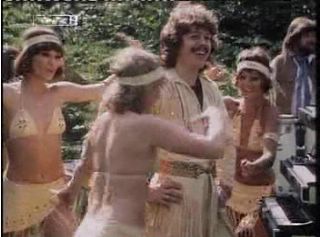

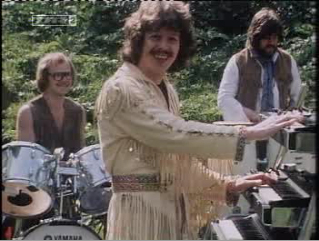
Friday, July 01, 2005
Even the former doctor for the President's father hates America now...
The Stain of Torture
By Burton J. Lee III
Friday, July 1, 2005; Page A25
Having served as a doctor in the Army Medical Corps early in my career and as presidential physician to George H.W. Bush for four years, I might be expected to bring a skeptical and partisan perspective to allegations of torture and abuse by U.S. forces. I might even be expected to join those who, on the one hand, deny that U.S. personnel have engaged in systematic use of torture while, on the other, claiming that such abuse is justified. But I cannot do so.
It's precisely because of my devotion to country, respect for our military and commitment to the ethics of the medical profession that I speak out against systematic, government-sanctioned torture and excessive abuse of prisoners during our war on terrorism. I am also deeply disturbed by the reported complicity in these abuses of military medical personnel. This extraordinary shift in policy and values is alien to my concept of modern-day America and of my government and profession.
The military prides itself, as do physicians, on being professional in every sense of the word. It fosters leadership and discipline. When I served as White House physician, my entire professional staff was drawn from the military, and they were among the best and most competent people I have met, without qualification.
The military ethics that I know absolutely prohibit anything resembling torture. There are several good reasons for this. Prisoners should be treated as we would expect our prisoners to be treated. Discipline and order in the military ranks depend to a large extent on compliance with the prohibition of torture -- indeed, weak or damaged psyches inclined toward torture or abuse have generally been weeded out of the military, or at the very least given less responsibility. In addition, military leaders have long been aware that torture inflicts lasting damage on both the victim and the torturer. The systematic infliction of torture engenders deep hatred and hostility that transcends generations. And it perverts the role of medical personnel from healers to instruments of abuse.
Today, however, it seems as though our government and the military have slipped into Joseph Conrad's "Heart of Darkness." The widespread reports of torture and ill-treatment -- frequently based on military and government documents -- defy the claim that this abusive behavior is limited to a few noncommissioned officers at Abu Ghraib or isolated incidents at Guantanamo Bay. When it comes to torture, the military's traditional leadership and discipline have been severely compromised up and down the chain of command. Why? I fear it is because the military has bowed to errant civilian leadership.
Our medical code of ethics requires us to oppose torture wherever it is inflicted, for any reason. Guided by this ethic, I served as a volunteer with the international group MEDICO in 1963, taking care of people who had been tortured by the French during Algeria's civil war. I remain deeply affected by that experience today -- by the people I tried to help and could not, and by their families, which suffered the most terrible grief. I heard the victims' stories, examined their permanently broken bodies and looked into faces that could not see me because of the irreparable damage done not only to their senses but also to their brains. As I have studied reports of torture throughout our troubled world since then, I have always found comfort in knowing that at least it did not occur here, not among Americans.
Now that comfort is shattered. Reports of torture by U.S. forces have been accompanied by evidence that military medical personnel have played a role in this abuse and by new military ethical guidelines that in effect authorize complicity by health professionals in ill-treatment of detainees. These new guidelines distort traditional ethical rules beyond recognition to serve the interests of interrogators, not doctors and detainees.
I urge my fellow health professionals to join me and many others in reaffirming our ethical commitment to prevent torture; to clearly state that systematic torture, sanctioned by the government and aided and abetted by our own profession, is not acceptable. As health professionals, we should support the growing calls for an independent, bipartisan commission to investigate torture in Iraq, Afghanistan, Guantanamo Bay and elsewhere, and demand restoration of ethical standards that protect physicians, nurses, medics and psychologists from becoming facilitators of abuse.
America cannot continue down this road. Torture demonstrates weakness, not strength. It does not show understanding, power or magnanimity. It is not leadership. It is a reaction of government officials overwhelmed by fear who succumb to conduct unworthy of them and of the citizens of the United States.
The writer is a former physician to the president to George H.W. Bush and a board member of Physicians for Human Rights.
The Stain of Torture
By Burton J. Lee III
Friday, July 1, 2005; Page A25
Having served as a doctor in the Army Medical Corps early in my career and as presidential physician to George H.W. Bush for four years, I might be expected to bring a skeptical and partisan perspective to allegations of torture and abuse by U.S. forces. I might even be expected to join those who, on the one hand, deny that U.S. personnel have engaged in systematic use of torture while, on the other, claiming that such abuse is justified. But I cannot do so.
It's precisely because of my devotion to country, respect for our military and commitment to the ethics of the medical profession that I speak out against systematic, government-sanctioned torture and excessive abuse of prisoners during our war on terrorism. I am also deeply disturbed by the reported complicity in these abuses of military medical personnel. This extraordinary shift in policy and values is alien to my concept of modern-day America and of my government and profession.
The military prides itself, as do physicians, on being professional in every sense of the word. It fosters leadership and discipline. When I served as White House physician, my entire professional staff was drawn from the military, and they were among the best and most competent people I have met, without qualification.
The military ethics that I know absolutely prohibit anything resembling torture. There are several good reasons for this. Prisoners should be treated as we would expect our prisoners to be treated. Discipline and order in the military ranks depend to a large extent on compliance with the prohibition of torture -- indeed, weak or damaged psyches inclined toward torture or abuse have generally been weeded out of the military, or at the very least given less responsibility. In addition, military leaders have long been aware that torture inflicts lasting damage on both the victim and the torturer. The systematic infliction of torture engenders deep hatred and hostility that transcends generations. And it perverts the role of medical personnel from healers to instruments of abuse.
Today, however, it seems as though our government and the military have slipped into Joseph Conrad's "Heart of Darkness." The widespread reports of torture and ill-treatment -- frequently based on military and government documents -- defy the claim that this abusive behavior is limited to a few noncommissioned officers at Abu Ghraib or isolated incidents at Guantanamo Bay. When it comes to torture, the military's traditional leadership and discipline have been severely compromised up and down the chain of command. Why? I fear it is because the military has bowed to errant civilian leadership.
Our medical code of ethics requires us to oppose torture wherever it is inflicted, for any reason. Guided by this ethic, I served as a volunteer with the international group MEDICO in 1963, taking care of people who had been tortured by the French during Algeria's civil war. I remain deeply affected by that experience today -- by the people I tried to help and could not, and by their families, which suffered the most terrible grief. I heard the victims' stories, examined their permanently broken bodies and looked into faces that could not see me because of the irreparable damage done not only to their senses but also to their brains. As I have studied reports of torture throughout our troubled world since then, I have always found comfort in knowing that at least it did not occur here, not among Americans.
Now that comfort is shattered. Reports of torture by U.S. forces have been accompanied by evidence that military medical personnel have played a role in this abuse and by new military ethical guidelines that in effect authorize complicity by health professionals in ill-treatment of detainees. These new guidelines distort traditional ethical rules beyond recognition to serve the interests of interrogators, not doctors and detainees.
I urge my fellow health professionals to join me and many others in reaffirming our ethical commitment to prevent torture; to clearly state that systematic torture, sanctioned by the government and aided and abetted by our own profession, is not acceptable. As health professionals, we should support the growing calls for an independent, bipartisan commission to investigate torture in Iraq, Afghanistan, Guantanamo Bay and elsewhere, and demand restoration of ethical standards that protect physicians, nurses, medics and psychologists from becoming facilitators of abuse.
America cannot continue down this road. Torture demonstrates weakness, not strength. It does not show understanding, power or magnanimity. It is not leadership. It is a reaction of government officials overwhelmed by fear who succumb to conduct unworthy of them and of the citizens of the United States.
The writer is a former physician to the president to George H.W. Bush and a board member of Physicians for Human Rights.
Subscribe to:
Posts (Atom)


